

Why Email Marketing Feels Like a Hit-or-Miss Channel
Most businesses don’t quit email marketing because it fails completely. They quit because it feels unpredictable.
One campaign performs well, bringing clicks, replies, or even sales. The next campaign, sent to the same list with similar effort, barely gets noticed. Over time, this inconsistency creates doubt. Business owners start wondering if email marketing is worth the time anymore.
The truth is simple. Email marketing is not unpredictable. The way it’s usually done is.
When emails are sent without understanding how subscribers behave, results naturally feel random. Email campaign analytics tools help you understand what’s working, why it’s working, and how to do it again.
What Data-Driven Email Marketing Looks Like in the Real World
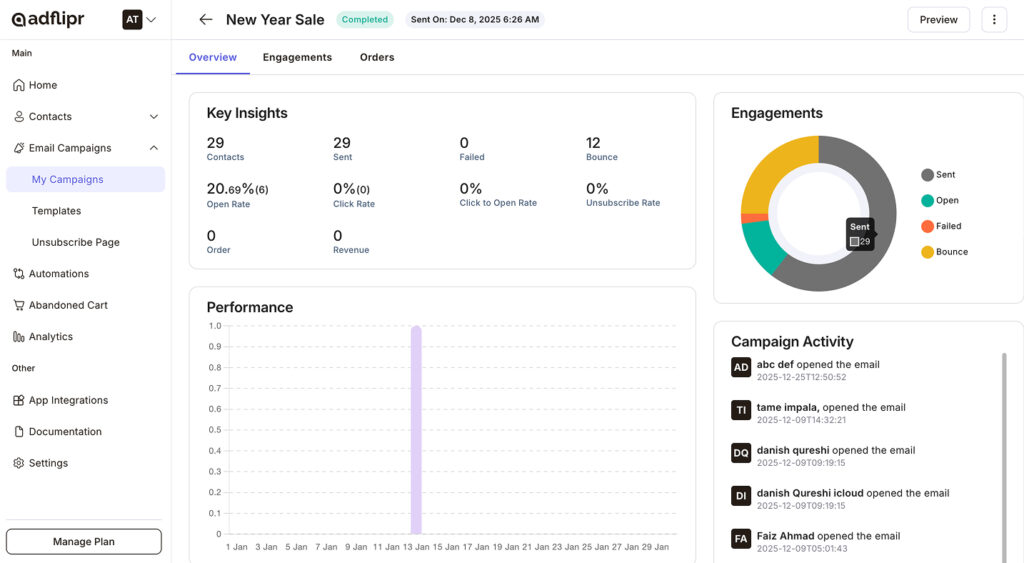
Data-driven email marketing is not about complex dashboards or technical jargon. It’s about paying attention to signals your audience already gives you.
Every time someone opens an email, clicks a link, or ignores a message, they’re telling you something. When you connect these actions, you start seeing patterns instead of guessing.
For example, you may notice that a portion of your list consistently clicks emails that explain how your product works, but rarely clicks promotional offers. That insight tells you education builds trust for them, not discounts.
Without data, this insight is invisible. With data, it becomes a clear direction.
Why Most Email Campaigns Fail to Drive Sales
Many email campaigns fail not because the offer is bad, but because the message is sent blindly.
Businesses often send emails because:
- It’s time for a newsletter
- A promotion needs visibility
- A competitor is running a campaign
What’s missing is intent. Without understanding where subscribers are in their journey, emails feel generic. Generic emails rarely convert.
Data-driven email marketing helps you recognize intent. It allows you to spot when someone is curious, when they’re comparing options, and when they’re ready to buy. Sales increase when emails align with these moments.
The Metrics That Actually Tell a Sales Story
Not all numbers matter equally. Some metrics exist to inform decisions, others just create noise.
Open rates tell you if your subject line and timing worked. Click-through rates reveal interest, not just attention. Conversion data shows which emails influence real buying decisions. Engagement trends over time help you identify subscribers who are warming up or losing interest.
When you stop looking at metrics in isolation and start reading them as a story, email marketing becomes easier to improve.
How Data-Driven Email Marketing Increases Sales (With Examples)
Example 1: Why High Engagement Doesn’t Always Mean High Sales
Imagine you run an online business and notice one campaign has strong open and click rates, but almost no purchases. Many marketers would move on, assuming the audience isn’t interested.
A data-driven approach reveals something else. People are interested, but they hesitate at the final step.
By reviewing behavior, you discover that most users drop off after clicking the pricing link. You follow up with a short email explaining the value, answering common objections, and highlighting a key benefit.
Sales increase without changing the product or running ads. The data pointed directly to the problem.
Example 2: Selling More by Sending Less
Another business notices something unexpected. Emails sent on certain days consistently outperform others, regardless of content.
Instead of increasing email frequency, the business adjusts timing based on engagement data. Emails now reach subscribers when they’re most responsive.
The result is higher sales, fewer emails, and a more engaged list. This is what efficiency looks like when data guides decisions.
Why Relevance Is the Real Sales Multiplier
Subscribers don’t ignore emails because they hate email. They ignore emails because the content doesn’t feel meant for them.
Data allows you to segment your audience based on behavior. Buyers receive different messages than browsers. Engaged readers receive different content than inactive subscribers.
When emails feel relevant, engagement improves naturally. When engagement improves, sales follow.
Turning Email Marketing Into a Learning System
One of the biggest mindset shifts with data-driven email marketing is how you view campaigns.
Instead of asking, “Did this email work?” you ask, “What did this email teach us?”
Each campaign becomes feedback. Subject lines teach you what captures attention. Click data shows what sparks curiosity. Conversion data reveals what drives decisions.
Over time, this learning compounds. Email marketing stops being experimental and starts becoming predictable.
Why Analytics and Automation Belong Together
Data shows you what subscribers are doing. Automation allows you to respond while the interest is still fresh.
When someone clicks but doesn’t buy, automation can follow up. When someone stops opening emails, automation can re-engage them. When someone purchases, automation can upsell or educate.
Platforms like Adflipr bring analytics and automation into one place, making it easier to act on insights instead of letting them sit in reports.
Why Many Businesses Still Struggle With Email Data
The problem is rarely lack of data. It’s lack of direction.
Tracking too many metrics, reviewing reports without action, or treating all subscribers the same prevents progress. Data-driven email marketing works only when insights lead to change.
How to Start Using Data Without Overthinking It
You don’t need to redesign your entire strategy overnight. Start small.
Look at your last five campaigns. Identify which ones drove clicks and which ones drove sales. Ask why. Make one change in your next campaign based on what you learned.
Progress in email marketing comes from consistent improvements, not dramatic overhauls.
Conclusion: Email Marketing Becomes Powerful When You Understand Your Audience
Email marketing becomes motivating again when it makes sense.
Data-driven email marketing gives you confidence because decisions are no longer guesses. You know what your audience responds to, when they’re ready to engage, and how to guide them toward a purchase.
Sales grow not because you send more emails, but because every email has a purpose.
If you want clearer insights and smarter automation that helps you turn email engagement into real growth, explore how Adflipr helps businesses use data to send better, more effective emails.
