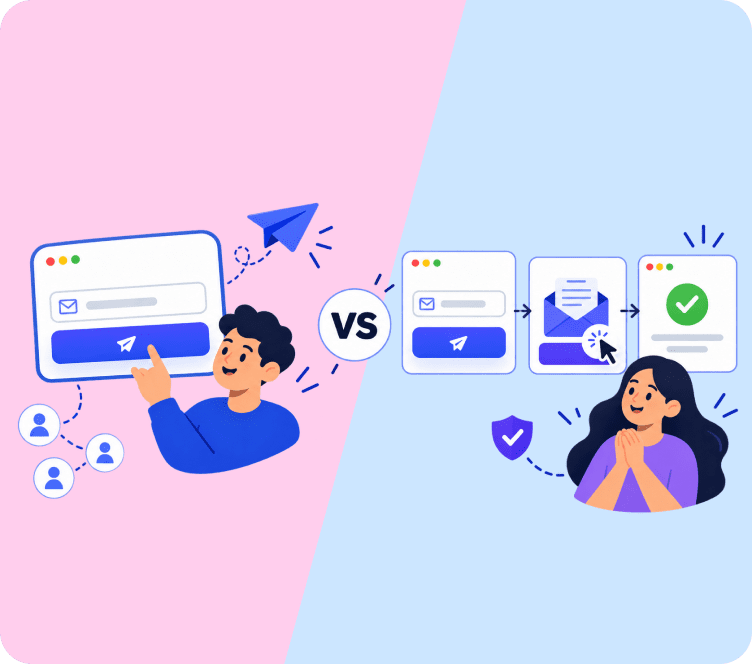

I have rebuilt enough email campaigns from scratch to know the pattern: a client swears their subject lines are fine, their design is fine, and the list is just “not that engaged.” Nine times out of ten, the real issue is that four or five small things are quietly working against each other. Fix them together and opens, clicks, and actual sales tend to move at the same time. Below are seven changes I come back to on almost every account, in the order I would tackle them if I only had an afternoon.
Quick answer: The email marketing tips that move the needle fastest are: test subject lines with real A/B splits, segment your list so each send feels relevant, add specific social proof near your call to action, open with a short story instead of a pitch, send at the time your audience actually opens email, create urgency with a real deadline, and track conversion rate (not just opens) so you know what is actually working.
1. Improve Your Subject Lines
Stop guessing and run a simple A/B test: send two subject line variants to a small slice of your list, then send the winner to everyone else a few hours later. Try a few distinct styles: a direct benefit (“20% off ends tonight”), a curiosity hook (“you are missing out on this”), plain urgency (“last chance”), and pay attention to which one actually wins with your audience, not what a “best practices” article says should win. Every list is a little different.
Keep subject lines under roughly 50 characters so they do not get clipped on mobile, where most people open email first, and skip the ALL CAPS and stacked exclamation points. They read as spam before anyone even opens the message.
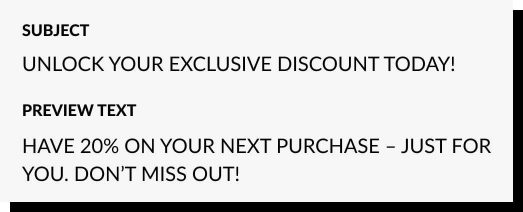
The subject line is the only thing standing between your email and the trash icon. Get it right and everything else in this list has a chance to work; get it wrong and none of it matters.
2. Segment Your Audience for Targeted Campaigns
Sending the same email to your entire list is the fastest way to make a list stop caring. Split people by behavior (recent purchase, browsing history, email engagement), interest, or basic demographics. Four segments cover most accounts to start: new subscribers, repeat customers, cart abandoners, and people who have gone quiet. A win-back message to that last group should look nothing like a loyalty reward to your best customers. If it does, you are leaving open rate on the table. Our guide on email marketing segmentation walks through setting these groups up properly.
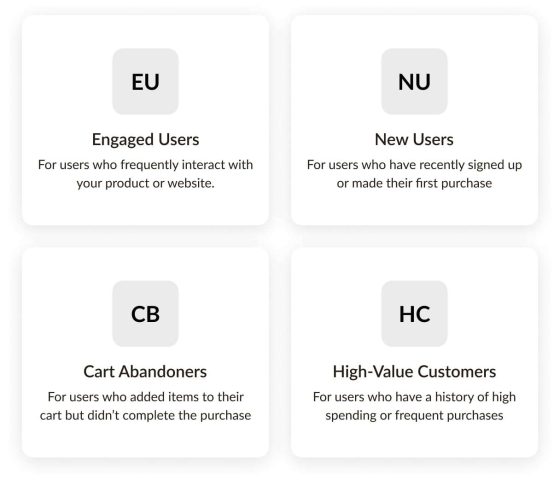
A segmented email is simply more relevant, and relevant emails get opened, clicked, and acted on. People can tell within a second or two whether a message was written for them or blasted to everyone, and they react accordingly.
3. Incorporate Social Proof
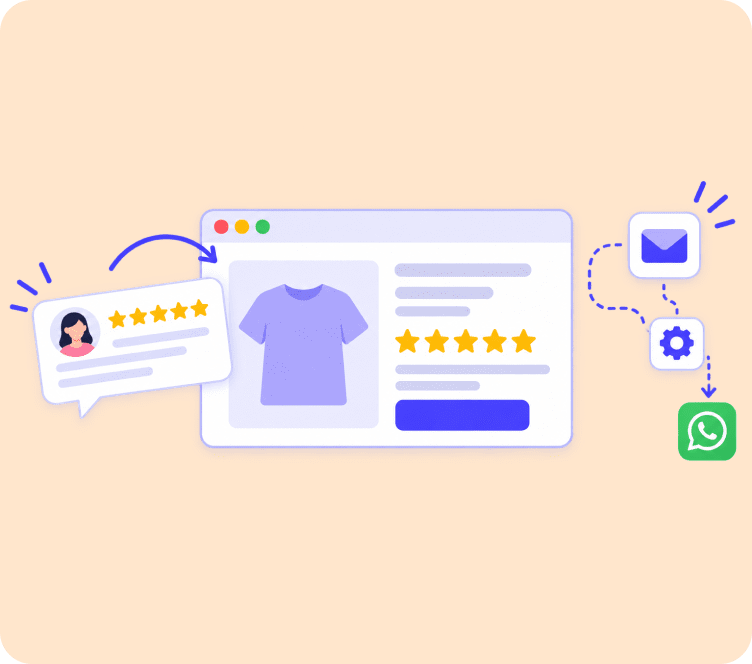
Verified reviews, star ratings, testimonials, real customer photos, or even a simple line like “Join 12,000+ happy customers” all do the same job: they tell a hesitant reader that other people already trusted this and it worked out. Where you place it matters as much as what it says, so put it near the call to action, not buried above the fold where no one is deciding anything yet.
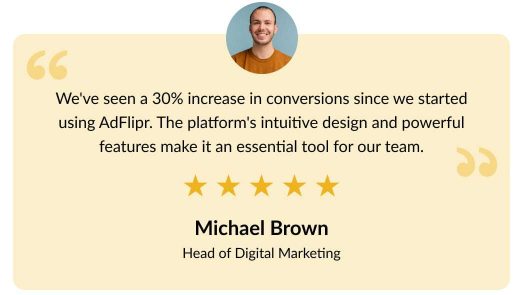
Social proof works because trust, not information, is usually what is missing at the point of decision. Seeing that real people already vouched for you does more to move someone to click than another paragraph of features ever will.
4. Tell a Story
Open with two or three sentences about a real customer, how the product came to exist, or a specific problem your brand set out to fix, then move into the offer. This is the section people skip when they are in a rush to write an email, and it is exactly why so many campaigns get ignored past the first line. A short, specific story gives a reader a reason to keep reading instead of scanning for the discount code and bouncing.
People remember stories, not bullet points. A reader who feels something in the first two lines is far more likely to stay through the pitch than one who was handed a straight sales pitch cold.
5. Create Urgency with a Countdown Timer
A countdown timer or a hard deadline shows exactly how much time is left, and it should always be paired with a specific, real reason: “sale ends at midnight” or “only 8 left in stock,” rather than urgency for its own sake. Readers have gotten very good at spotting fake urgency, and a “limited time” banner that has run for three months quietly trains people to ignore every future one you send.
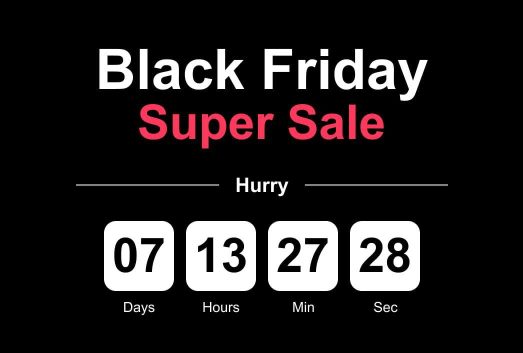
Real deadlines change behavior because the cost of waiting becomes concrete. A vague “limited time” is easy to put off; a timer hitting zero at 11:59 tonight is not.
6. Send at the Time Your Audience Actually Opens Email
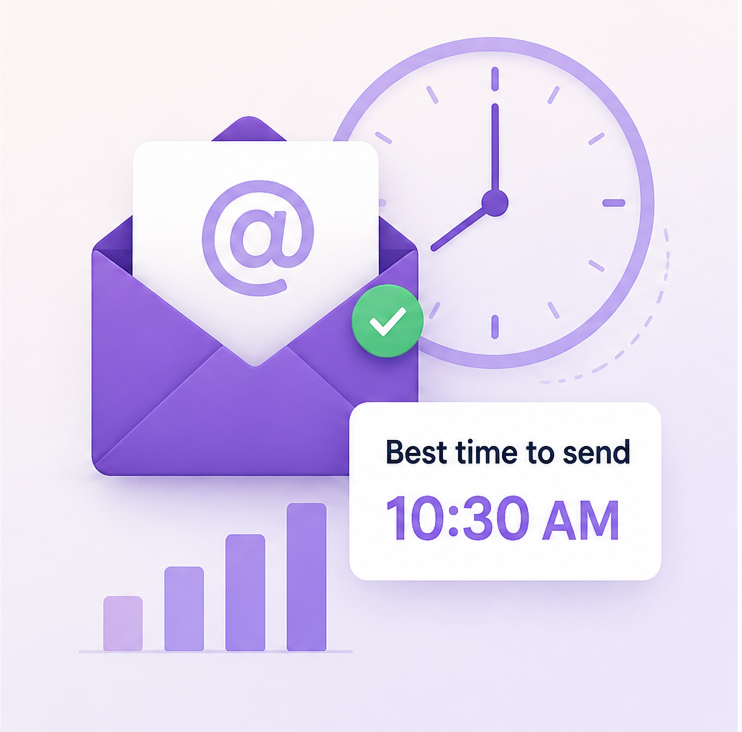
Even a great email underperforms if it lands in an inbox at the wrong moment and gets buried by the time your subscriber checks their phone. As a starting point, mid-morning (around 9–11am) and early evening (around 7–9pm) tend to outperform late-night or very early sends across most consumer lists, but “tends to” is doing a lot of work in that sentence. Your own list is the only data that actually matters. Most email platforms report open rate by hour and day; pull that report before you assume a generic “best time” applies to your subscribers.
Once you have a rough window, test it deliberately: send half your list at your current time and half at the new window for two or three campaigns, then compare. Send-time optimization is one of the few changes here that costs zero design or copywriting effort and can still move open rate meaningfully.
7. Track the Metrics That Actually Show Conversions
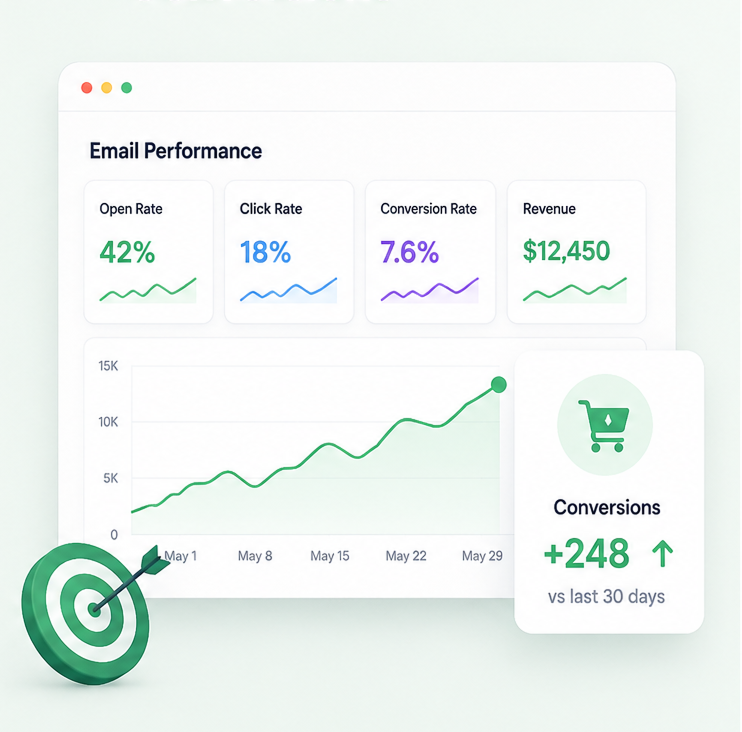
Open rate feels good to report, but it is not the metric that pays the bills. A campaign with a mediocre open rate and a strong conversion rate is doing its job; a campaign with a great open rate and no sales is not, no matter how the dashboard looks at a glance. Track click-through rate as the middle step, then conversion rate (the share of recipients who completed the action you actually wanted) as the number that tells you whether the email worked.
A useful rule of thumb: if open rate is healthy but conversion rate is flat, the problem is usually the offer, the landing page, or a mismatch between what the subject line promised and what the email delivered, not the email itself. Fix that gap before you touch anything else on this list.
Key Takeaways
- Test subject lines with real A/B splits instead of guessing what will work
- Segment your list so each email matches the recipient’s behavior or interests
- Add specific social proof near your call to action, not just anywhere in the email
- Open with a short story before you pitch, to keep readers engaged past the first line
- Use real, specific deadlines to create urgency; vague urgency gets ignored
- Send when your list actually opens email, based on your own reporting, not a generic rule
- Track conversion rate, not just opens, to know whether a campaign genuinely worked
Final Thoughts
None of these seven changes require a redesign or a bigger budget, just a subject line test, a cleaner segment, a customer quote in the right spot, a two-sentence story, a real deadline, a send time based on your own data, and a dashboard that tracks conversions instead of vanity metrics. Applied together, they compound: each one removes a small reason a subscriber had to stop reading or not click, and email marketing tips like these are worth revisiting every few months as your list and your offers change.
For the complete step-by-step process behind building a campaign like this from scratch, see our full guide on how to create an email campaign.
FAQs
Test subject lines, segment your audience, add social proof, tell a short story, send at the right time, and track conversion rate, not just opens.
Test every campaign if possible, or at least every few sends. Compare open rates over time to spot what consistently works for your audience.
Segmentation means splitting your list into smaller groups by behavior, interests, or purchase history, so each group receives content relevant to them.
Social proof includes customer reviews, star ratings, testimonials, user photos, or simple stats like “12,000+ customers” placed near your call to action.
Yes, specific, real deadlines like a countdown timer or limited stock count reliably drive faster action than vague phrases like “limited time.”
Mid-morning and early evening perform well for most lists, but check your own platform’s open-rate-by-hour report; your list’s pattern beats any general rule.
Conversion rate, not open rate. A campaign can have great opens and no sales; track how many recipients completed the action you wanted.
Start by A/B testing your subject lines. It takes no design work and gives you fast, measurable data on what resonates with your audience.