
A survey that goes unanswered tells you nothing. The difference between a customer feedback survey that gets real responses and one that gets ignored usually comes down to timing, length, and how the request is framed, not the survey tool itself and not the incentive attached to it.
Quick answer: A customer feedback survey works best sent right after delivery or support, kept to 3 to 5 questions, and focused on one recent experience. Follow up once, and close the loop when feedback leads to a real change.
Time the Survey to a Specific Moment
Generic, un-triggered surveys sent to your whole list tend to get low response rates because they ask people to reflect on something vague. An email survey tied to a specific, recent moment performs better because the experience is still fresh in the customer’s mind.
Good moments to trigger a customer feedback survey:
- A few days after a product is delivered
- Right after a support ticket is closed
- Shortly after a return or exchange is completed
Sending a survey two weeks after delivery, once the customer has already moved on mentally, will always get weaker recall and lower response rates than one sent a few days after.
Keep It Short on Purpose
Every additional question lowers your completion rate. A customer feedback survey with 3 to 5 focused questions will almost always outperform a 15-question form, even if the longer one seems more thorough on paper.
Start with a simple rating question (a 1 to 5 scale or a single "how satisfied were you" question), then follow with one or two open-ended questions only if the rating is low or high enough to be worth exploring further. This structure, sometimes called branching, keeps the survey short for most people while still capturing detail from the responses that matter most.
Keep Every Question Neutral
A leading question quietly damages the entire survey, even if everything else about it is well designed. Asking "How much did you enjoy our fast, friendly service?" already tells the customer what answer you’re hoping for, and it skews responses toward agreement instead of honest reflection.
- Leading: "How much did you enjoy our exceptional customer service?"
- Neutral: "How would you rate our customer service?"
The neutral version gets a real answer instead of a socially agreeable one. This matters most in questions about service quality, staff friendliness, or anything where the customer might feel a mild social pressure to be polite rather than honest. When a question implies its own answer, the resulting data looks better than reality, which is worse than useless since it can lead a team to believe something is working when it isn’t.
Question order matters too. Starting with a broad, easy question and moving toward more specific ones helps a respondent warm up before you ask for real detail, rather than opening with the hardest question first and losing them before they’ve built any momentum.
Ask About One Thing, Not Everything
A well-designed survey email focuses on one part of the experience, like the unboxing, the product itself, or the support interaction. Trying to cover shipping, product quality, pricing, and support in one form usually produces vague, low-effort answers because the respondent is not sure what the survey actually wants from them.
- Post-purchase survey: focus on the product and unboxing experience
- Post-support survey: focus on the resolution and response time
- Post-return survey: focus on why the product did not work out
Write the Ask Like a Person, Not a Form
The subject line and opening line of a survey email matter as much as the questions inside it. "We’d love your feedback" is generic enough to be ignored. A more specific line, like "How was your experience with
?", references something real and gets noticed faster in a crowded inbox full of near-identical requests.
Keep the tone conversational and explain briefly why the feedback matters, without over-explaining. One short sentence is usually enough.
Choosing the Right Question Format
Not every question needs the same format, and picking the wrong one is a quiet way to lose response quality even when the timing and length are right.
- Star or number rating (1 to 5): best for a quick pulse check on satisfaction. Easy to answer on mobile, easy to analyze in bulk.
- Net Promoter Score (0 to 10, "how likely are you to recommend us"): useful if you want a single number to track over time, but less useful for diagnosing a specific problem on its own.
- Multiple choice: good for narrowing down a known set of issues, like "what was the main reason for your return," where you already know the likely answers.
- Open text: the most useful format when something genuinely needs more than one word, but the one most likely to get skipped if it’s the first or only question in the survey.
A practical pattern that works well: lead with a rating question, since it takes five seconds to answer and gives almost everyone a reason to continue, then follow with one open text question only if the rating suggests there’s something worth explaining further.
What to Do When the Feedback Is Negative
A low rating or a critical comment is more valuable than a string of five-star ratings with no detail, because it tells you exactly what to fix. The mistake most stores make is treating a bad response as something to log and move past, rather than something to act on quickly.
- Follow up personally within a day or two, ideally from a real person, not an automated reply
- Ask one clarifying question if the complaint is vague, rather than guessing at the problem
- Fix what you can fix, and be honest about what you can’t
- Track recurring complaints separately from one-off issues, since a pattern across many responses matters more than any single comment
A customer who leaves negative feedback and then sees it acted on, even in a small way, often becomes more loyal than one who never had a problem in the first place. Ignoring the complaint entirely is what actually damages the relationship, not the criticism itself. A short, genuine reply, even one that can’t fully solve the problem, tends to land better than a generic "we’re sorry to hear that" template with no real acknowledgment of the specific issue raised.
Close the Loop When Feedback Leads to a Change
If a pattern shows up across multiple rounds of feedback, like frequent complaints about a specific product’s sizing, acting on it and mentioning that change later (even briefly, in an unrelated email) shows customers their feedback actually goes somewhere. This small step meaningfully improves response rates on future sends, since people are more willing to spend a minute on a customer feedback survey when they believe it leads somewhere. This same principle underlies most advice on surveys for brands: people respond when they can see the loop actually closes.
Key Takeaways
- Trigger a customer feedback survey around a specific, recent moment instead of sending it cold
- Keep each survey email to 3 to 5 questions to protect your completion rate
- Write neutral questions, not leading ones, and order them from broad to specific
- Focus each survey on one part of the experience, not the entire customer journey
- Lead with a rating question, then use open text only when the rating suggests it’s worth exploring
- Write the request like a real message, referencing the actual product or interaction
- Follow up quickly and personally when feedback is negative, since that response matters more than the complaint itself
- Close the loop publicly when feedback leads to a real change
Final Thoughts
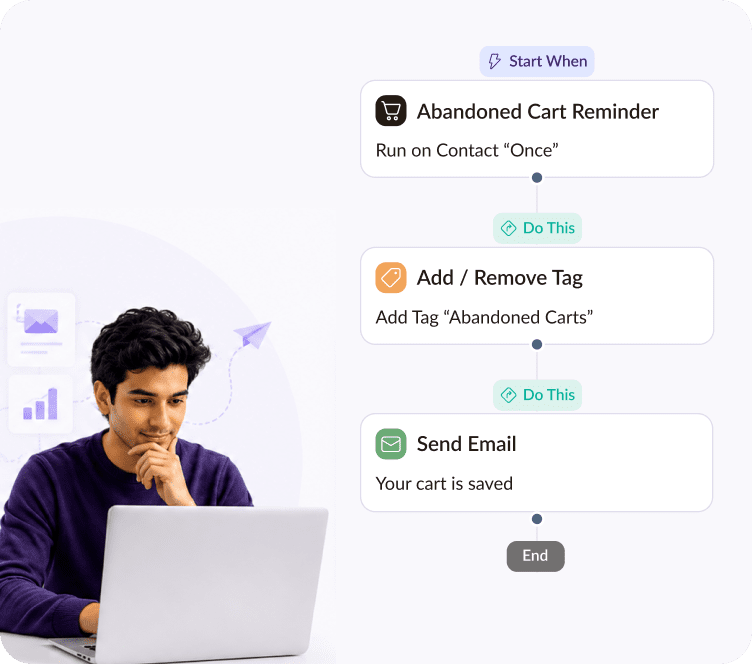
A customer feedback survey works best as a habit, not a one-off campaign. Triggering it automatically after the right moments, delivery, support resolution, or a return, means you collect consistent feedback without manually remembering to send anything. Well-timed surveys, run consistently and reviewed regularly, will always beat a single big survey blast sent once a year. If you are also looking to turn happy responses into public reviews, our glossary entry on review request emails covers that related, but distinct, type of message. Feedback like this also feeds directly into our guide on user retention strategies, since a survey response is often the earliest warning sign of a customer at risk of churning, well before they stop opening your emails entirely.
FAQs
A few days after delivery or right after a support interaction, while the experience is still fresh in the customer’s mind.
Keep it to 3 to 5 focused questions. Longer surveys usually see a sharp drop in completion rates.
It can help, but a well-timed, short survey often gets solid response rates without needing a discount attached.
Branching shows extra questions only when a response, like a low rating, makes more detail genuinely useful and worth collecting.
Follow up personally within a day or two, ask a clarifying question if needed, and fix what you can. Silence does more damage than the complaint itself.
Yes. A feedback survey gathers honest input for internal use, while a review request aims to publish public reviews.
Trigger it at the right moment, keep it short, and show customers that feedback leads to real change over time.
NPS asks how likely someone is to recommend you, useful for tracking over time. A rating question checks satisfaction with one specific moment.
Use multiple choice when you already know the likely answers, like return reasons. Use open text only when you genuinely need more detail.
A question that implies its own answer, like “How much did you enjoy our great service?” It skews responses toward agreement instead of honest feedback.
Start broad and easy, then move toward more specific questions. This lets the respondent warm up before you ask for detailed feedback.