Here is a number most fashion store owners have never checked: what percentage of your customers ever place a second order. For a typical apparel store, it is under 30 percent. Seven out of ten people buy once, like what they got, and still never come back. Not because they were unhappy. Because nothing brought them back.
That is the specific problem email marketing for fashion stores exists to solve. Not sending newsletters. Closing the gaps where apparel stores actually lose money: fit doubt at checkout, silence after the first order, stock that sits until markdown, and sizes that come back without anyone knowing who wanted them. Below is each gap, and how email closes it, automatically.
70% of fashion carts are abandoned, and fit doubt is the top reason
Under 30% of apparel customers ever place a second order
60 days is roughly how long the second purchase window stays open
25-35% of revenue comes from email in stores that run it properly
Fashion Has a Retention Problem Disguised as a Traffic Problem
When revenue dips, the instinct is to buy more traffic. But apparel margins cannot survive paying for the same customer twice. The stores that win in fashion are not the ones with the most visitors. They are the ones that turn a first order into a buying habit, and that is a retention job. Ads cannot do retention. Email can, because it is the only channel that knows who bought what, in which size, and when.
One-and-done buyers
Most apparel customers never return. Not from dissatisfaction, but from silence.
Discount addiction
Constant sale blasts teach full-price buyers to wait, and margin erodes season by season.
Blind merchandising
Stock decisions get made without knowing which customers are waiting for which products and sizes.
Cart Recovery in Fashion Is About Fit, Not Price
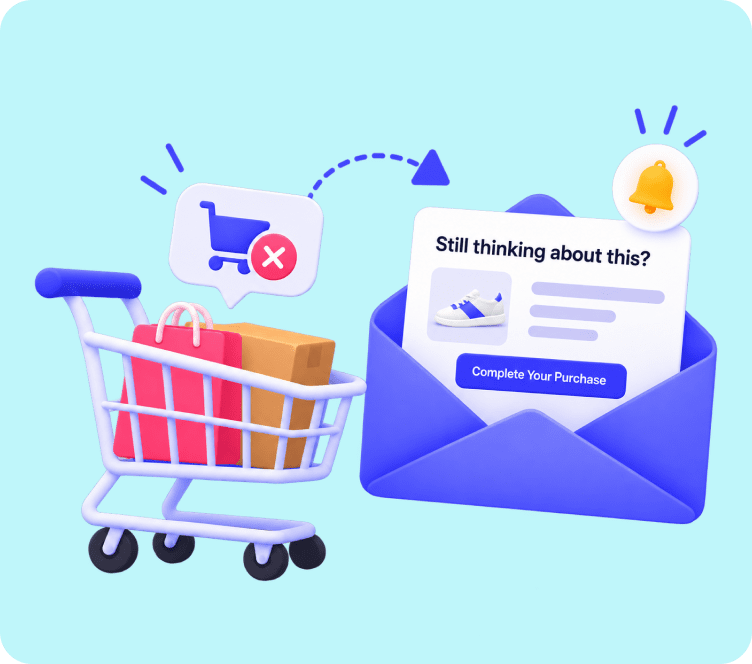
Here is what generic advice gets wrong about abandoned cart emails: it assumes people abandon over price, so it leads with discounts. In apparel, the data says otherwise. The top reasons are fit uncertainty, return policy doubt, and simple distraction. So the recovery sequence should sell confidence, not coupons.
Within 1 hour
Show the exact items with a one-click path back to checkout. Intent is still warm, and for many shoppers this reminder alone closes the sale.
At 24 hours
This is the fit email. Size guide, model measurements, fabric details, and your return policy in plain words. You are removing the doubt that caused the pause.
At 48 to 72 hours
The final nudge, with urgency if stock is genuinely low. A discount belongs here only if margin allows, and never earlier, or you train shoppers to abandon carts on purpose.
Cart and checkout are two different exits. A shopper who never opened checkout has product doubt, so remind them of the product. A shopper who stopped at the payment step has trust doubt, so answer returns, delivery, and payment security. Splitting these into two flows is worth roughly double the recovered revenue of one generic reminder.
A Fashion Email List Is Only as Good as the Data Attached to It
Most stores collect an email address and nothing else. Then every future send is a guess. The signup moment is your one chance to capture the data that makes fashion email marketing work: size, category preference, and style. Three ways to get it:
The style quiz signup
Thirty seconds, three questions: what do you shop, what size, what style. It converts as well as a discount popup and hands you segmentation data no ad platform can sell you.
Early access instead of discounts
For drop-driven and premium brands, access beats percent-off. It protects margin and attracts buyers who care about the brand, not the coupon.
Back-in-stock as list growth
A “notify me in my size” button on sold-out products captures your highest-intent visitors, the ones already sold and just waiting on inventory.
The Second Purchase Window Closes in About 60 Days
This is the most expensive thing fashion stores do not know: the odds of a second order peak in the first 30 to 60 days after the first one, then fall off a cliff. Wait for your next big campaign to reach them and the window is already shut. Post-purchase emails work that window automatically.
Style the purchase
Right after the order: how to wear it, what pairs with it. You are building outfit thinking, and outfit thinking creates the next order.
Check the fit
A few days after delivery. Catching a fit issue early turns a silent return into an exchange, and a refund into kept revenue.
Ask for the review
About a week after delivery, when the item has been worn. Fit-mention reviews then reduce the next customer’s fit doubt too.
Cross-sell the completion
At three to four weeks: the matching piece, in their size, at the moment rebuy odds are highest.
Segment the Way Fashion Actually Sells: Category, Size, Price, Loyalty
Generic tools segment by opens and clicks. A fashion marketer segments by how apparel is actually bought. Four segments do most of the revenue work, and your store data builds all of them.
Category buyers
The denim drop goes to denim buyers. Cross-category launches go to your VIP customers first, because breadth of category is the strongest loyalty signal in apparel.
Size-based segments
“Your size is back” restock alerts are among the highest-converting emails in fashion because the intent already exists. They also show you which sizes to reorder deeper.
Full-price vs sale shoppers
Never send markdowns to people who happily pay full price. Protecting this segment from coupons is the single most margin-positive rule in fashion email.
Lapsing customers
Flag buyers approaching day 90 with no second order and reach them before they go cold. Fashion has no replenishment cycle, so newness, not discounts, is the win-back lever.
Moving from full-list blasts to these four segments typically lifts revenue per email by 30 percent or more.
Related industries:
Email Marketing for Fashion Stores Runs on Store Data
One requirement sits under every tactic on this page: your email platform must see what happens in your store as it happens. Orders, carts, product categories, sizes, and inventory. Without that connection, cart recovery cannot trigger, restock alerts cannot fire, and segments have nothing to build from. Whether you sell on Shopify, WooCommerce, or anywhere else, hold your email tool to three tests:
Variant-level sync
In fashion, the variant is the size. If your tool sees “Linen Shirt” but not “Linen Shirt, size M,” it cannot send a restock alert or build a size segment.
Real-time triggers
A cart email that fires hours late misses the window. Flows should trigger from live store events, not from a nightly import.
Segments without spreadsheets
A segment like “bought dresses in the last 6 months, size M” should take a few clicks. If it takes a CSV export, the tool cannot run a fashion program.
Use Email to Fix Sell-Through, Not Just to Announce Sales
End-of-season markdowns are where fashion margin goes to die. Smart stores use email upstream of the markdown, moving stock at better prices before clearance is the only option left.
Mid-season pushes
Slow movers go to the segments most likely to want them, styled into outfits with bestsellers, weeks before any price cut.
Tiered sale access
When markdowns come: VIP customers first, subscribers second, public last. Early access converts loyalty into faster sell-through at shallower discounts.
Drop sequences
For launches: tease, launch day, last chance. Scarcity is honest in fashion because stock really does run out, so say so.
Gifting seasons
Gift guides split by recipient and budget outperform generic holiday blasts and pull full-price sales from shoppers who never browse.
How Adflipr Helps
Every piece of email automation for fashion brands described on this page comes prebuilt in Adflipr, so the difference is not what gets done, it is how much of your week it takes. Here is the honest comparison:
| The job | Manually or with a generic email tool | With Adflipr |
|---|---|---|
| Recovering abandoned carts | Export cart data, build the flow from scratch, one generic reminder for cart and checkout alike | Split cart and checkout flows, prebuilt with fit-focused timing, live from day one |
| Size restock alerts | Not possible without variant tracking, so a mass “back in stock” blast to everyone | “Your size is back” sent automatically, only to the shoppers who asked for that size |
| Segmentation | Build lists by hand from CSV exports, redo them every month as data goes stale | Category, size, price-behavior, and VIP segments build and update themselves from store data |
| Post-purchase follow-up | Remember to send it, per order, per customer, which means it never happens | Styling, fit check, review request, and cross-sell fire automatically inside the 60-day window |
| Win-back of lapsing buyers | Notice a customer went quiet? Nobody does, until the yearly re-engagement blast | Buyers approaching day 90 are flagged and reached automatically, before they go cold |
| Knowing what email earns | Guess from open rates, or stitch reports together across tools | Revenue tracked per email, per flow, per segment |
| Your monthly bill | Priced on total list size, so you pay for every dead address | Active contact billing, so you pay for subscribers who engage |
The WooCommerce integration is native and real-time, down to product variants. And the flows above are switched on, not built.
✓ Prebuilt fashion flows
✓ Variant-level store sync
✓ Revenue tracking per email
✓ Active contact billing
Frequently Asked Questions
Almost never because they disliked the product. In most apparel stores, under 30 percent of customers ever reorder, and the cause is silence: no styling follow-up, no fit check, no reason to return before the memory fades. The second purchase window peaks within 30 to 60 days of the first order. Automated post-purchase emails work that window. Waiting for your next campaign misses it.
Three, on a 1 hour, 24 hour, and 48 to 72 hour rhythm. The first is a reminder, the second handles fit and returns, the third adds urgency. Separate cart abandonment from checkout abandonment into two flows, since product doubt and payment doubt need different answers. That split, plus the full sequence, recovers roughly double what one generic reminder does.
Usually not. In apparel, carts are abandoned over fit uncertainty, return policy doubt, and distraction more than price. Lead with the product image, size guide, and returns in plain language. Hold any discount for the final email and only if margin allows. Discounting in email one trains shoppers to abandon carts deliberately, which quietly resets your real price downward.
In fashion email marketing, two to four campaigns per week works in peak seasons, one to two otherwise, with automated flows running on top. But frequency is the wrong number to watch. Watch revenue per email and unsubscribe rate per send. If unsubscribes pass 0.5 percent, the fix is almost always tighter segmentation, not fewer emails, because irrelevance burns a list faster than volume does.
Email driving 25 to 35 percent of total store revenue is the realistic benchmark, once core automations and the four fashion segments are live. Expect welcome open rates above 40 percent, cart sequences converting 5 to 15 percent of abandons, restock alerts converting at several times campaign average, and segmented sends earning 30 percent more per email than blasts. Steady state takes two to three months.