
Every few years, someone declares email marketing dead, usually right as a newer platform launches and grabs everyone’s attention. The claim keeps resurfacing, but the actual email marketing statistics behind usage and revenue have never really supported it, no matter how loudly the prediction gets repeated each time.
Quick answer: No, email marketing is not dead. Billions of people still use email daily, and it remains one of the highest-ROI marketing channels available. What changed is inbox competition, not the channel itself.
The Usage Numbers Do Not Support "Dead"
Anyone asking is email marketing dead usually has not looked at the actual usage numbers. Reports on global email usage consistently describe email as one of the largest active communication channels in the world, with billions of people using it and hundreds of billions of messages sent every day. That scale alone makes "dead" a strange word to apply to email. A channel with that much daily activity is not disappearing, and no serious usage report shows a decline. If anything, the volume keeps growing year over year, which is part of why competition for attention inside the inbox has gotten harder.
Email Still Has One of the Highest ROI Figures in Marketing
When people cite email marketing ROI as the reason to keep investing in the channel, they are usually pointing to independent industry reports that have repeatedly cited return-on-investment figures for email marketing that outperform most other digital channels, often somewhere in the range of $30 to $40 back for every $1 spent, though the exact figure varies by source, industry, and how the study is calculated. Even accounting for that variation, email consistently lands near the top of ROI comparisons, ahead of paid social and display advertising in most studies.
The reason is straightforward: email is a channel you own. Unlike a social platform, where reach depends entirely on an algorithm you do not control, your email list is yours. You decide who gets your message and when, without paying a platform for the privilege each time, and without an algorithm change quietly cutting your reach in half overnight.
Email vs Social Media, Directly Compared
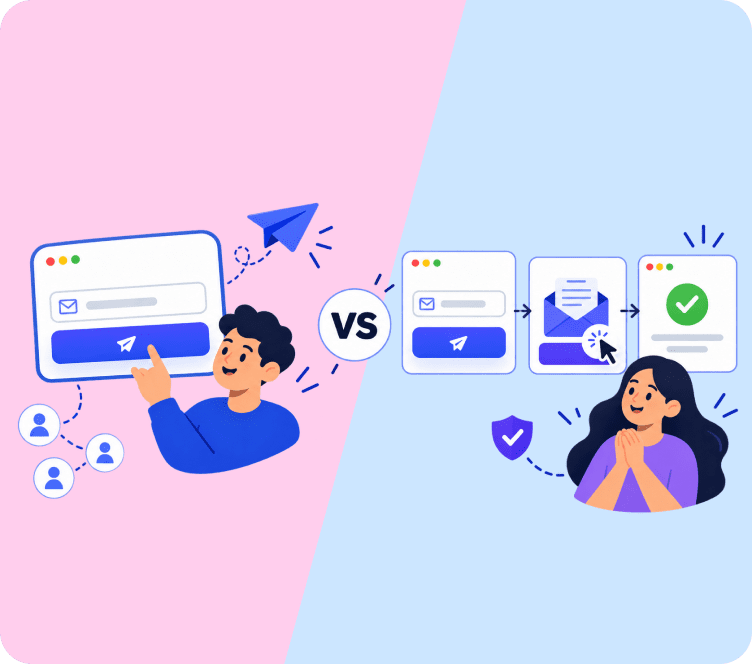
Put side by side, the gap between email and organic social reach is a big part of why email keeps outperforming, even as social platforms get more attention. Organic social posts on most platforms now reach a small single-digit percentage of a brand’s followers, since feeds are ranked to favor paid placement and high-engagement content over chronological reach. Email, by contrast, reaches essentially 100% of your list by default, since there’s no feed algorithm deciding whether a subscriber sees it. Reports comparing per-dollar returns across channels have consistently placed email’s ROI multiples higher than paid social’s, sometimes by an order of magnitude, though exact figures vary by study.
This isn’t an argument against social media. It’s a reason to treat the two as different jobs: social for discovery and awareness where algorithms decide reach, email for the direct, owned relationship where you decide reach.
The Real Challenges Behind the "Dead" Narrative
The "email marketing is dead" claim isn’t coming from nowhere. A few real trends explain why it keeps resurfacing, even though the underlying data doesn’t support it.
- Apple Mail Privacy Protection and similar privacy features pre-load images and can register a false "open" even when a subscriber never actually looks at the email, which makes open rate alone a less trustworthy metric than it used to be.
- AI-generated inbox summaries are starting to summarize emails before a person opens them, which changes how subject lines and preview text need to work, but doesn’t reduce the value of the email itself once it’s actually read or acted on.
- Inbox competition has genuinely increased, since more brands are sending more email than a few years ago, which raises the bar for what counts as a good send.
None of these trends make email less valuable. They make sloppy, unsegmented email less effective, which is a different problem with a different fix: better targeting and better content, not abandoning a channel that still reaches nearly everyone with an inbox.
What's Actually Changing Is the Bar, Not the Channel
The real shift in 2026 is not that email stopped working. It is that the low-effort version of email marketing, generic blasts sent to an entire list with no segmentation, stopped working as well as it used to. Inbox providers have gotten better at filtering low-engagement senders, and subscribers unsubscribe or mark spam faster than they did a few years ago.
What still performs well:
- Segmented sends based on real customer behavior, not a single list
- Automated flows triggered by specific actions (signup, purchase, cart abandonment)
- Personalized content based on past purchases, not generic promotions
Brands still running the same undifferentiated blast strategy from years ago are the ones seeing declining results, which likely fuels the "email is dead" narrative. The channel itself has not weakened. The tolerance for irrelevant email has, and that tolerance keeps shrinking every year.
Ecommerce Specifically Still Leans Heavily on Email
For ecommerce stores, email remains one of the most direct paths from an engaged subscriber to a completed sale, largely because of automated flows like abandoned cart and post-purchase sequences that convert without requiring a manual send every time. These flows run in the background and continue generating revenue long after they are set up, which is part of why email keeps showing up as a top revenue channel in ecommerce benchmarking reports.
How to Check If Your Email Marketing Is the Actual Problem
If email genuinely isn’t working for your store, the fix usually isn’t abandoning the channel, it’s diagnosing which specific part is actually broken. A few checks separate a real problem from a normal fluctuation.
- Check your list health first. A declining open rate across the board often points to a stale, unengaged list rather than a genuine content problem. Review when you last cleaned inactive subscribers and how large that inactive segment has grown.
- Look at automated flows separately from broadcast sends. If abandoned cart and welcome emails still convert well but your weekly newsletter doesn’t, the issue is the newsletter’s specific relevance and content, not email as a channel overall.
- Compare segmented sends against blasts. If a segmented send to recent buyers consistently outperforms a blast to your whole list, that gap is your answer: the channel works fine, the targeting doesn’t yet.
- Review your sender reputation. A sudden drop in open rates across every campaign type can be a deliverability issue landing emails in spam, not a genuine drop in customer demand or interest. Check your authentication settings and recent sending history before assuming customers have simply lost interest.
Running through these four checks usually surfaces the real problem within an afternoon, and it’s almost never "email doesn’t work anymore." It’s almost always one specific, fixable piece of the setup.
Key Takeaways
- Global usage and daily send volume for email remain enormous, not shrinking
- Independent ROI studies still place email marketing ROI among the highest of any marketing channel
- Email reaches close to 100% of your list by default, unlike organic social which reaches a small fraction of followers
- Privacy features and AI inbox summaries explain some of the "dead" narrative, but don’t reduce email’s actual value
- What changed is inbox competition, and segmented, automated email still outperforms generic blasts by a wide margin
- Ecommerce stores especially benefit from automated flows that run without manual sends
- If email feels like it’s failing, diagnose list health, flow performance, segmentation, and deliverability separately
Final Thoughts
Is email marketing dead? The data says no, but the version of email marketing that still works has moved on from one-size-fits-all newsletters. The email marketing statistics that matter most now are engagement and segmentation numbers, not just total list size. Stores that lean into segmentation and automation keep seeing strong results, while stores stuck on generic blasts see the opposite and mistake that for the channel failing entirely. If your current email program feels stuck, our guide on email marketing metrics and benchmarks is a good place to check where the gaps actually are, and Adflipr’s automation workflows can handle the segmented, triggered sends that perform best right now, without adding manual work to your team’s plate.
FAQs
Yes. Industry data continues to show strong usage numbers and high ROI for email, particularly when campaigns are segmented and automated.
The claim usually resurfaces alongside new platforms, but usage and revenue data for email have consistently stayed strong.
Various industry reports cite figures often in the $30 to $40 per $1 spent range, though this varies by industry and source.
Yes, especially through automated flows like abandoned cart and post-purchase sequences, which convert consistently without manual sends.
Generic, unsegmented blasts sent to an entire list tend to underperform and are often what people mean when they call email “dead.”
Not based on current data. Social reach depends on algorithms you don’t control, while your email list remains a channel you own and control directly.
Email reaches close to 100% of a list by default. Organic social posts typically reach only a small single-digit percentage of followers due to feed algorithms.
Not useless, but less precise. Pre-loaded opens can inflate the number, so click-through rate is often a more reliable signal now.
Not necessarily. Check list health, flow performance, segmentation, and sender reputation separately before concluding the channel itself has stopped working for your store.
A sudden drop in open rates across every campaign type, not just one send, usually points to a deliverability issue rather than reduced interest.