
If your emails aren’t getting opened, the problem usually isn’t your offer. It’s your subject line.
Every ecommerce store sends emails. Welcome emails, abandoned cart reminders, flash sale alerts, post-purchase follow-ups. But most of these emails never get read because the subject line fails to earn that first click. Writing the best subject lines for email marketing is not about being clever. It’s about being clear, relevant, and timed right. A good marketing email subject line earns attention without overpromising.
In this guide, we’ll walk through what actually works in 2026, based on real email data, real ecommerce examples, and the mistakes that quietly kill open rates. We’ll also look at how AI tools, like the one built into Adflipr, can speed up subject line writing without making your emails sound robotic.
What You’ll Learn From This Guide
- What actually makes a subject line work for ecommerce, not generic advice
- Real 2026 data on open rates, character length, and what’s changing
- A simple 5-step process to write a good subject line for any email
- Subject line examples for welcome, cart recovery, promo, and win-back emails
- The exact words and phrases that send emails to spam, and how to avoid them
- How an AI subject line generator for ecommerce can speed up your workflow
What Makes a Subject Line “The Best” for Your Store
A good subject line does three things at once. It tells the reader what’s inside, it creates a reason to open now instead of later, and it matches the tone your brand actually uses.
There’s no single “best” subject line that works for every store. A subject line that works for a skincare brand running a flash sale might fail completely for a B2B WooCommerce store selling office supplies. The best subject line is the one that fits your audience, your offer, and the moment they’re in.
That said, certain patterns consistently outperform others across ecommerce email subject lines. We’ll break those down next.
How Subject Lines Affect Open Rates and Revenue
A marketing email subject line isn’t just about getting opens, it directly affects your revenue per email sent.
Recent research analyzing billions of subject lines found that shorter subject lines, under 25 characters, drive the most opens and clicks for regular campaign emails. But for triggered emails, like cart recovery or post-purchase follow-ups, medium-length subject lines between 25 and 35 characters actually drive more conversions, because they give the shopper enough context to act.
This matters a lot for Shopify and WooCommerce stores, since most of your highest-converting emails (cart abandonment, browse abandonment, win-back) are triggered, not broadcast campaigns. Treating every subject line the same way is one of the biggest reasons open rates stay flat.
The same research also found that personalization in subject lines doesn’t move the needle much for cold campaigns, but previous purchasers consistently open emails at higher rates than new contacts, no matter how the subject line is written. In other words, your segmentation matters as much as your wording.
What the Data Says About Subject Lines in 2026
Subject lines aren’t just a creative exercise anymore, there’s real data behind what works. If you’re serious about optimizing your email marketing subject lines, these numbers are a good place to start. Here’s what recent research across millions of emails shows:
- About 47% of recipients open emails based on the subject line alone, which is why this one line carries more weight than almost any other part of your email.
- A study covering 5.5 million emails found that subject lines with 2 to 4 words hit the highest open rates, around 46%, while performance consistently drops once you go past 7 words.
- Subject lines of 33 characters or fewer are the only length that displays fully across all mobile email clients, which matters since most of your subscribers are reading on their phones.
- Brands using AI to generate and optimize subject lines see roughly a 26% increase in open rates compared to manually written ones, and that lift compounds further when paired with send-time optimization.
- Personalized subject lines can lift open rates by 20% to 26%, based on data from Adobe and Campaign Monitor.
- On the flip side, around 69% of spam flags trace back to suspicious subject line patterns, things like ALL CAPS, stacked exclamation points, or words like “FREE” and “act now.”
- Misaligned subject lines, where the email content doesn’t match what was promised, drive 30.4% of recipients to unsubscribe. It’s one of the top reasons subscribers leave your list.
- Welcome emails average a 54.3% open rate in ecommerce, by far the highest of any automated flow, which is exactly why the subject line on your first welcome email deserves extra attention.
- Segmented campaigns generate 14% higher open rates and double the click rate compared to sending the same email to your full list, a reminder that subject line wording only does half the work, the right audience does the rest.
Turn more visitors into paying customers, automatically
Set up abandoned cart recovery, welcome flows, and post-purchase emails in minutes, built specifically for Shopify and WooCommerce stores.
Email Subject Line Best Practices
These are the core email subject line best practices that consistently perform well across ecommerce stores, whether you’re on Shopify, WooCommerce, or both. Following these consistently is what separates the best subject lines for email marketing from the ones that get ignored.
Keep It Short and Specific
Aim for 25 to 50 characters, roughly 4 to 8 words. Mobile inboxes cut off anything longer, and most of your subscribers are checking email from their phone.
Example for a Shopify store: “Your cart misses you 🛒” Example for a WooCommerce store: “20% off ends tonight”
Lead With the Benefit, Not the Brand Name
Most store owners default to writing their brand name first. Customers don’t care about your brand name as much as what’s in it for them. Lead with the value.
Weak: “Adflipr Newsletter, June Edition” Stronger: “3 ways to recover lost sales this week”
Use Real Urgency, Not Fake Urgency
Urgency works, but only when it’s true. If your ’24-hour sale’ runs for a week, customers notice, and it damages trust over time. The best subject lines for sales use real deadlines tied to your actual promotion.
Match Subject Line Length to Email Type
This is one of the most overlooked email subject line best practices. Campaign emails (newsletters, promos) perform best when short. Triggered emails sent through your marketing automation flows, like abandoned cart, order confirmation, or post-purchase, perform best slightly longer, since the customer already has context and wants detail.
Test Numbers and Specificity
Numbers make a subject line feel concrete. “5 styles back in stock” performs better than “New styles back in stock” because it sets a clear expectation.
Use Emojis Sparingly, If At All
Emojis used to be a reliable open rate booster. That’s changing. Recent data shows that for many ecommerce sends, subject lines without emojis now outperform those with emojis, especially for revenue-focused emails like cart recovery. If you do use one, stick to a single relevant emoji, never more.
Avoid All Caps and Excess Punctuation
Subject lines like “HUGE SALE!!! DON’T MISS OUT!!!” trigger spam filters and look unprofessional. One exclamation point, if any, is enough.
Words and Phrases That Can Send You to Spam
This is one of the most important email subject line best practices, and the one most store owners overlook. Spam filters scan subject lines for specific words and patterns before your email even reaches the inbox. Use too many of these, and even genuine offers end up buried in the spam or promotions folder.
Here are common spam trigger words and phrases to avoid or use very carefully:
Money and urgency related:
- “Free,” “Cash,” “Earn money,” “Make $$$,” “Risk-free,” “No cost”
- “Act now,” “Apply now,” “Don’t wait,” “Urgent,” “Time is running out”
Sales and promotion related:
- “Buy now,” “Order now,” “Click here,” “Special promotion,” “Once in a lifetime”
- “100% guaranteed,” “Best price,” “Lowest price,” “Discount” (when overused repeatedly)
Formatting issues that trigger filters:
- Writing the whole subject line in ALL CAPS
- Stacking punctuation like “!!!” or “???”
- Excessive use of the dollar sign or percentage symbol, like “$$$ SAVE NOW $$$”
Misleading or exaggerated claims:
- “You’ve been selected,” “Congratulations, you won,” “This isn’t spam”
- Any subject line that promises something the email doesn’t actually deliver
This doesn’t mean you can never use words like “free” or “sale.” A subject line like “Free shipping on your next order” is completely normal for ecommerce and rarely causes issues on its own. The real problem is stacking multiple trigger words together, using excessive punctuation, or writing in all caps, since spam filters look at the combination, not just one word in isolation. For a deeper breakdown, see our guide on why emails go to spam.
A safer approach: write your subject line, then read it back and ask if it sounds like something a real person would write to a friend, or if it sounds like a mass blast. If it leans toward the second, soften the language before sending. This single habit protects your sender reputation and keeps your future emails landing in the inbox instead of spam. If you want to go deeper on how your overall email content affects deliverability, this guide on email text vs content ratio is worth a read.
How to Write a Good Subject Line in 5 Steps
If you’re wondering how to write a good marketing email subject line from scratch, here’s a simple framework you can use for any email.
Step 1: Identify the one thing you want the reader to know. Don’t try to summarize the whole email. Pick the single most important point.
Step 2: Write 5 versions, not 1. Your first subject line idea is rarely your best one. Write five quick variations before picking a winner.
Step 3: Match the tone to the email type. A flash sale subject line should feel urgent. A thank you email should feel warm. A re-engagement email should feel curious, not desperate.
Step 4: Check the character count on mobile. Most inboxes show 30 to 40 characters on mobile. If your subject line gets cut off mid-sentence, shorten it.
Step 5: A/B test before sending to your full list. Test your email campaign subject lines by sending two versions to a small segment first, then send the winner to the rest of your list. Most email marketing automation tools, including Adflipr, support this natively
Best Subject Lines for Different Email Types (With Ecommerce Examples)
Different emails need different subject line strategies. Getting ecommerce email subject lines right means matching tone to intent, and here’s how this plays out for Shopify and WooCommerce stores specifically.
Welcome Emails
These should feel friendly and set expectations.
Shopify example: “Welcome! Here’s 10% off your first order” WooCommerce example: “Thanks for joining us, here’s what’s next”
Abandoned Cart Emails
This is one of the highest-revenue email types for any ecommerce store, and the subject line needs to remind, not pressure.
Shopify example: “You left something behind” WooCommerce example: “Still thinking it over? Your cart is saved”
If you’re running abandoned cart recovery on Shopify or WooCommerce, the subject line on the first email in the sequence matters more than the second or third, since that’s where most recoveries happen.
Promotional and Sale Emails
These can use urgency and numbers more directly, and the best subject lines for sales usually combine a real deadline with a specific number.
Example: “Last day: 30% off everything” Example: “$10 off, just for today”
Post-Purchase and Win-Back Emails
These should feel personal and value-driven, not salesy.
Post-purchase example: “How’s your order treating you?” Win-back example: “We miss you, here’s 15% to come back”
Re-engagement Emails
These work best when they’re honest about the gap in contact.
Example: “Still want emails from us?” Example: “It’s been a while, here’s what you missed”
Subject Line Styles: Comparison Table
| Style | Best For | Example | Avoid When |
|---|---|---|---|
| Direct benefit | Promo, sale emails | “20% off your next order” | Email lacks a real offer |
| Question hook | Re-engagement, curiosity | “Still deciding?” | Overused, can feel gimmicky |
| Urgency/scarcity | Flash sales, cart recovery | “Last chance: sale ends tonight” | Deadline isn’t real |
| Personalization | Post-purchase, loyalty | “John, your next reward is ready” | Cold or first-touch emails |
| Numbers/list | Newsletters, tips content | “5 ways to style this for summer” | Transactional emails |
| Plain and simple | Order updates, confirmations | “Your order has shipped” | Promotional campaigns |
Common Mistakes of Email Subject Lines
Even experienced marketers fall into these traps. Here are the common mistakes of email subject line writing that quietly hurt open rates and deliverability.
Writing the subject line last. When you write it after the email body, it usually feels like an afterthought, generic and rushed. Write it first, or at least draft it early.
Misleading the reader. If your subject line promises a discount but the email is just a newsletter, customers feel tricked. This damages trust and increases unsubscribes.
Using spam trigger words. Words like “free,” “guaranteed,” “act now,” combined with excessive punctuation, can land your email in spam instead of the inbox. See the full list of words and phrases to avoid above, in the best practices section.
Sending the same subject line style every time. If every email says “Sale Ends Today,” subscribers stop believing it. Rotate your approach.
Ignoring mobile preview. A subject line that looks great on desktop can get cut off awkwardly on mobile, where most of your subscribers are actually reading.
Not testing at all. Many small stores skip A/B testing because it feels like extra work. But testing even two subject lines per campaign builds a pattern of what your specific audience responds to over time.
Forgetting the preheader text. The preheader is the second line shoppers see in their inbox. If you leave it blank, your platform usually pulls random text from the email body, which can look messy. If cart recovery emails are a big part of your revenue, this guide on how to reduce cart abandonment covers strategies that go beyond subject lines.
How an AI Subject Line Generator for Ecommerce Can Help You Write Better Subject Lines
Writing strong subject lines for every single campaign, flow, and automation gets tiring fast, especially if you’re running a store on your own or with a small team. This is where an AI subject line generator for ecommerce becomes genuinely useful, not as a replacement for your judgment, but as a faster starting point.
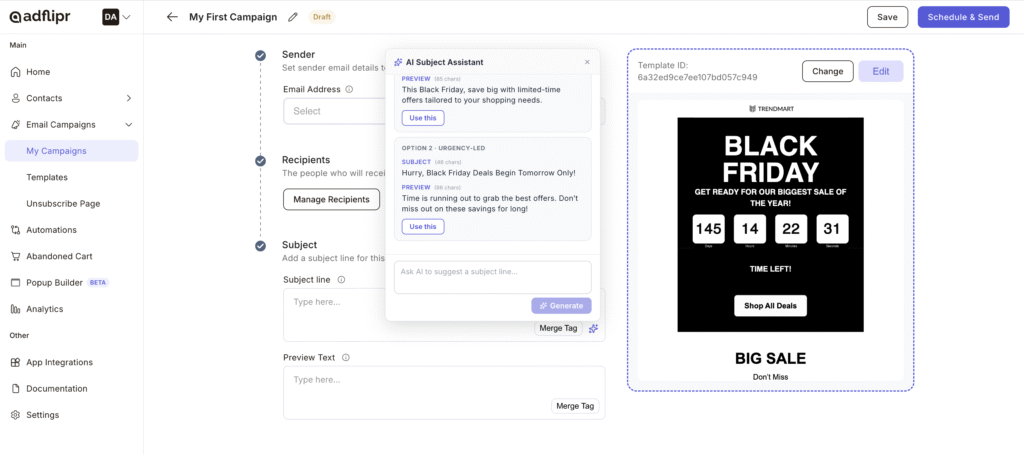
Adflipr has its own AI subject line generator for ecommerce, built specifically for Shopify and WooCommerce sends. Instead of giving you generic, one-size-fits-all suggestions like most general AI writing tools, it looks at your email content and campaign type (cart recovery, promo, post-purchase, welcome, and so on) and generates subject line options that fit that exact email, along with feedback on length, tone, clarity, and spam risk before you hit send.
This matters more for ecommerce stores than it might seem. Most subject line generators are built for generic marketing emails and have no idea what a cart recovery flow or a post-purchase sequence actually needs. Adflipr’s AI subject line generator for ecommerce is built around the email types Shopify and WooCommerce stores send most often, so the suggestions are grounded in what tends to perform for stores like yours, not generic copywriting advice pulled from unrelated industries.
You still make the final call on tone and wording. The tool just gives you several ready-to-use subject line options in seconds, flags weak or spammy phrasing, and checks character limits before anything goes out to your full list. That saves real time without making your emails sound like they were written by a bot. You can see which plans include this feature on the Adflipr pricing page.
Best Practices Checklist
Before you hit send, run through this quick list. Think of it as a final email open rate optimization pass on every campaign:
- Subject line is under 50 characters for campaigns, slightly longer for triggered emails
- The benefit or offer is clear, not vague
- No more than one emoji, if any
- No spam trigger words or excessive punctuation
- Preheader text is filled in, not left blank
- Tone matches the email type (urgent for sales, warm for post-purchase)
- You have at least two versions ready to A/B test
- Subject line matches what’s actually inside the email
At the end of the day, writing the best subject lines for email marketing comes down to a few honest habits: know your email type, lead with the benefit, keep it short, and test instead of guessing. Whether it’s a flash sale on Shopify or a cart recovery sequence on WooCommerce, the subject lines that win are the ones built around what your customer actually cares about in that moment. Run a few campaigns with these habits in place, and you’ll likely see the difference in your open rates within the first two or three sends.
FAQ
What is the best subject line for email marketing?
There isn’t one universal best subject line. The best subject lines for email marketing are short, specific, and matched to the email type. For promotions, direct and urgent works well. For post-purchase or welcome emails, a warmer, more personal tone performs better.
How does a good subject line work?
A good subject line works by giving the reader just enough information to know what’s inside the email and a reason to open it now. It avoids being vague, avoids overpromising, and stays close to what the email actually delivers.
Why is the subject line important in email marketing?
The subject line is the first thing a subscriber sees in their inbox. If it doesn’t grab attention or clearly communicate value, the email gets ignored, no matter how good the content inside is. It directly affects your open rate, click rate, and overall email revenue.
What are common mistakes of email subject lines?
The most common mistakes of email subject lines include misleading claims, overused urgency, spam trigger words, ignoring mobile character limits, and writing the same style of subject line for every campaign. These mistakes lower open rates and can hurt deliverability over time.
How do I write a good subject line for an abandoned cart email?
Keep it simple and non-pushy. Something like “You left something behind” or “Still thinking it over?” works well because it reminds the customer without sounding desperate. Save urgency for the second or third email in the sequence.
Is personalization in subject lines worth it?
Personalization helps more for post-purchase and loyalty emails than for cold campaigns. Referencing a customer’s name or recent activity works best when there’s already a relationship, rather than on a first-touch promotional email.
Should I use emojis in email subject lines?
Use them sparingly, and only when relevant to the message. Recent data shows that emoji-free subject lines often perform just as well, or better, for revenue-focused emails like cart recovery, since shoppers respond more to clear context than visual decoration.
What words should I avoid in an email subject line so it doesn’t go to spam?
Avoid stacking words like “free,” “cash,” “guaranteed,” “act now,” and “click here,” especially combined with ALL CAPS or excessive punctuation like “!!!” or “$$$.” One trigger word alone rarely causes issues, but combining several at once signals spam filters and can hurt your sender reputation over time.
Is AI useful for writing email subject lines for Shopify or WooCommerce stores?
Yes, when it’s built around ecommerce email types. General AI writing tools often give generic suggestions, but an AI subject line generator for ecommerce, like the one built into Adflipr, is designed around abandoned cart, post-purchase, and promotional emails specifically, which makes the suggestions more relevant for store owners.
How long should a subject line be?
For regular campaign emails, aim for under 25 to 30 characters to perform best on mobile. For triggered emails like cart recovery or order updates, 25 to 35 characters tends to convert better for email marketing subject lines, since the reader already has context and benefits from a bit more detail.
How often should I test my subject lines?
Test on every major campaign if possible, even if it’s just two variations. Over time, this builds a clear picture of what tone, length, and style your specific audience responds to, which is more valuable than following generic best practices alone.