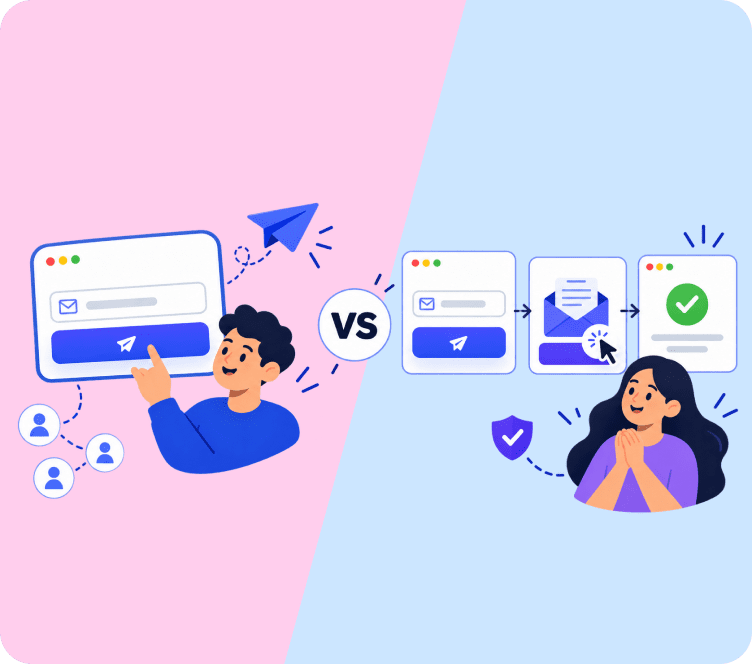

A shopper browses your Shopify or WooCommerce store anonymously, leaves, comes back on their phone, signs up for your newsletter, then buys from a different device three days later. Without something connecting those dots, your store sees four disconnected strangers instead of one continuous customer relationship. This connecting process is customer identity resolution, and it quietly sits behind almost every personalization and segmentation feature your email platform offers.
If you have ever asked what is identity resolution in the context of online retail, the answer lies in bridging the gap between anonymous clicks and known customer behavior.
Quick answer: So, what is identity resolution? It is the technology process that links a shopper’s scattered email addresses, device IDs, browsing behavior, and purchase activity into one complete account profile. For ecommerce stores, it is what makes personalization, RFM segmentation, and abandoned cart recovery actually work correctly.
Historically, unifying customer data across channels required enterprise-level data engineering teams. That has changed. Modern email marketing automation platforms handle this process automatically under the hood, bringing advanced data tools to growing online stores by default.
Why This Matters More Than It Sounds
Most online stores collect customer data in scattered pieces: an email address from a signup popup, browsing history from website cookies, purchase records from checkout, and support tickets from external helpdesk tools. Without proper customer data unification, each of these records lives in its own isolated silo.
The person who abandoned a cart on mobile yesterday and the person who just signed up for your newsletter on desktop today might be the exact same shopper, but your email systems have no way of knowing that unless an underlying identity system ties the two together. Combining data tracking with qualitative customer research methods gives store owners a complete view of who their buyers are.
This isn’t just a data-hygiene concern to fix later. Fragmented customer identities have direct, practical consequences that show up as lost revenue:
- Misfired Abandoned Cart Automations: Cart recovery flows miss shoppers whose cart activity happened under an anonymous session before they logged into their account.
- Inaccurate Audience Segmentation: Customer segments undercount your highest-value buyers because their order history is spread across multiple partial contact profiles.
- Generic Personalization: Product recommendations look irrelevant because the system lacks a complete view of what that specific shopper previously viewed or bought.
How the Identity Resolution Process Actually Works
The resolution process generally begins with what data engineers call the anonymous-to-known transition. A visitor browses your store with no identifying information beyond a temporary browser cookie. At some point, they provide an explicit identifier, such as entering an email address in a signup popup, completing customer feedback surveys, or applying a discount code at checkout.
That moment is the pivotal hinge point of the whole system. Once the anonymous session links to a verified identifier, all prior browsing history links to their permanent profile instead of getting lost in unlinked server logs.
Platforms reconcile these identifiers using two primary methods:
- Deterministic matching: Linking customer records using exact, verified identifiers, such as matching identical email addresses, phone numbers, or logged-in user IDs across different devices. This is the most reliable matching method by a wide margin.
- Probabilistic matching: Inferring that two separate sessions belong to the same person based on statistical patterns, such as shared IP addresses, device fingerprints, and matching browsing timelines when no exact identifier is present.
The primary output of this reconciliation process is a unified customer profile, which is sometimes referred to in data architecture as a golden record. This single, deduplicated profile combines every session, email open, and order under one master identity.
What This Looks Like in Practice for a Store Owner
You don’t need complex data engineering skills to benefit from identity resolution. If your email marketing platform automatically connects web tracking, email signups, and purchase history under one contact dashboard, you are already utilizing identity resolution.
The practical question worth auditing is whether your platform unifies multi-device behavior accurately. A quick audit takes about fifteen minutes:
- Pick three repeat customers whose purchasing history you recognize.
- Look up each customer in your email platform and check whether their full interaction history shows up under a single unified customer profile.
- Note any duplicate contact entries, such as the same person appearing twice with different partial histories.
- If duplicate profiles exist, check whether your platform features automated deduplication tools.
Running this check periodically matters because new duplicate records quietly accumulate over time as customers use guest checkout, switch devices, or opt in through secondary forms. Good email list hygiene practices rely heavily on keeping these profiles clean.
Where This Connects to Segmentation and Personalization
Accurate RFM segmentation (recency, frequency, monetary value) requires knowing a customer’s full purchase history under one profile, not scattered across duplicate contacts. Personalized product recommendations depend on seeing everything a customer has browsed and bought.
Unifying customer data forms the backbone of effective ecommerce user retention strategies, ensuring repeat buyers receive relevant recommendations and timely replenishment notices rather than generic promotional blasts.
Identity Resolution vs. Identity Graph: Understanding the Difference
These two technical terms get used interchangeably, but they represent distinct concepts:
- Identity Resolution: The operational process of matching and merging scattered customer identifiers into one profile.
- Identity Graph: The underlying database structure that stores those identifiers, maps relationships between devices and emails, and enforces privacy rules.
Resolution is the outcome; the identity graph is the infrastructure engine that produces it. Most ecommerce store owners never need to manage an identity graph directly, as modern marketing tools handle graph mapping automatically behind the scenes.
Privacy and Compliance Considerations (GDPR & CASL)
Consolidating customer data across touchpoints concentrates personal information into one place, which raises the importance of privacy compliance.
Any identity resolution system must comply with international data privacy frameworks:
- GDPR (General Data Protection Regulation): Requires explicit consent for tracking European shoppers and mandates honoring customer requests to access or delete their unified profiles.
- CASL (Canada’s Anti-Spam Legislation): Dictates strict implied and express consent rules for sending commercial messaging based on customer interaction history.
Consolidating data into a unified system does not create new legal obligations, but it makes handling consent preferences accurately across all channels essential.
Why Identity Resolution Matters More Now Than Ever
For years, brands relied on third-party cookies to track consumer behavior across the web. As web browsers restrict third-party tracking, first-party data, which is the data your store collects directly from visitors, has become the only reliable signal left.
Online stores that invest in customer data unification build resilient first-party data assets that privacy updates cannot disrupt.
Key Takeaways
- Asking what is identity resolution reveals how stores link fragmented browsing and purchase data into single profiles.
- The anonymous-to-known transition connects historical browsing to real profiles once an email or phone number is provided.
- Matching relies on deterministic matching (exact identifier matches) and probabilistic matching (pattern inference).
- Resolution creates a single golden record per customer, powering accurate segmentation and automation flows.
- Systems rely on an underlying identity graph while remaining compliant with privacy laws like GDPR and CASL.
Final Thoughts
Understanding customer identity resolution helps online merchants explain why personalization and segmentation sometimes feel incomplete. When customer activity is scattered across duplicate records, even the best email copy cannot overcome underlying data gaps.
Establishing clean data unification upfront empowers your store to deliver accurate automated campaigns that convert first-time visitors into loyal repeat customers.
Frequently Asked Questions
It is the process of connecting a shopper’s scattered identifiers, including email addresses, browsing history, and purchases across mobile and desktop, into one complete customer profile.
Deterministic matching uses exact identifiers like verified email addresses or login IDs, making it far more accurate than probabilistic matching, which relies on statistical pattern guesses.
A golden record is a single, fully deduplicated profile that combines all interaction data, purchases, and device histories for an individual customer.
By linking anonymous browsing sessions to known email addresses prior to checkout, allowing email platforms to send cart recovery emails even if the shopper did not fill out the checkout form during that specific session.