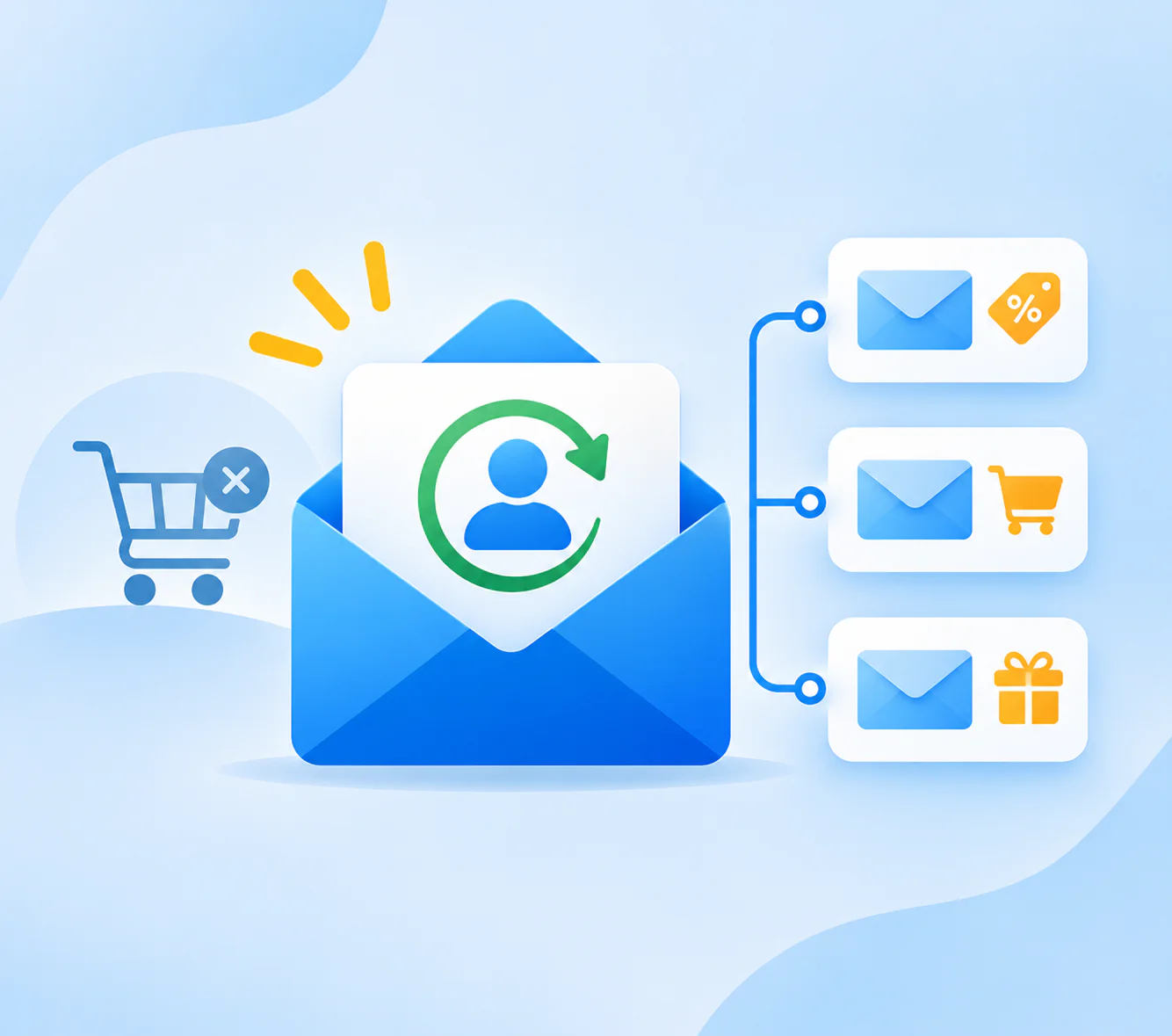
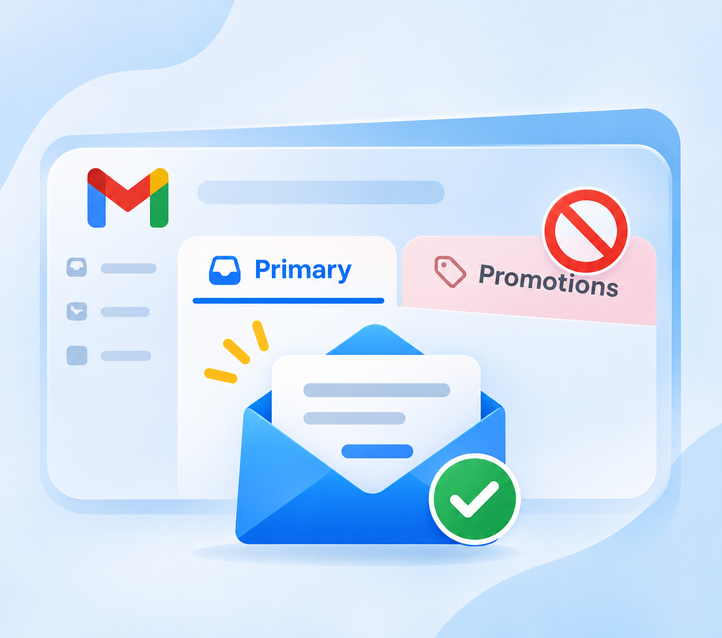
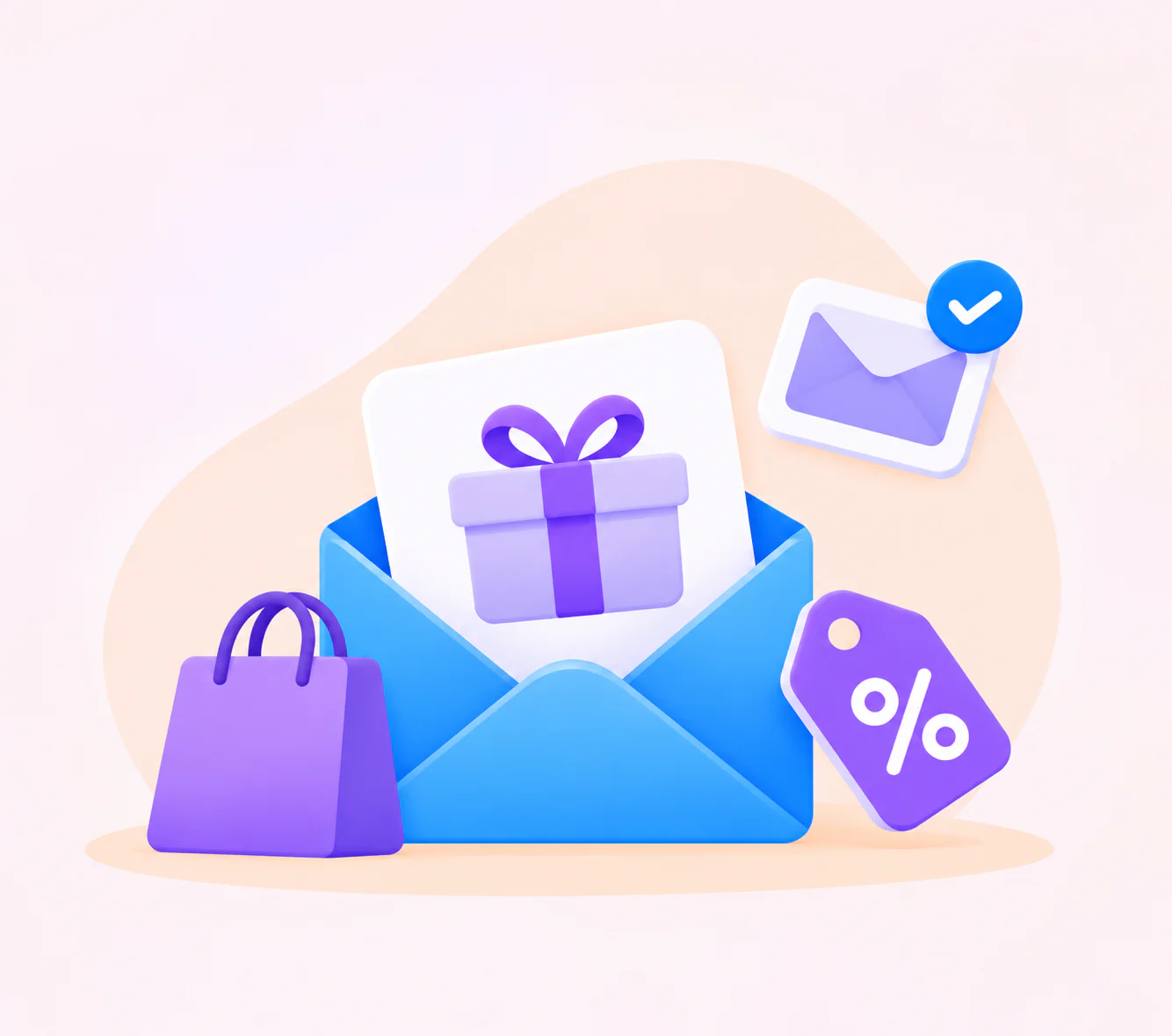
An email marketing campaign is a planned email, or a short series of emails, sent to a defined audience to achieve one goal: a first purchase, a recovered cart, a product review or a returning customer. Every revenue-generating email your business sends falls into this category, whether it is a welcome series greeting a new subscriber, a flash sale announcement, or an automated sequence nudging a customer toward a repeat purchase.
The difference between stores that consistently generate revenue from email and stores that treat it as an afterthought is not the platform they use or the size of their list. It is how deliberately they plan, execute, and optimise their campaigns.
This guide covers the 8 types of email marketing campaigns every online store needs, real examples with subject lines, a stage-by-stage plan for what to send first, a planning template, and a simple test that proves whether a campaign really made money. Last updated: November 2026.
Quick Answer: Email marketing campaigns are targeted emails sent to a subscriber list with a specific goal, such as driving a purchase, recovering an abandoned cart, or re-engaging inactive customers. The most effective campaigns are segmented, personalised, and tied to clear measurable outcomes.
What Are Email Marketing Campaigns?
An email marketing campaign is a coordinated series of emails sent to a defined audience with a specific objective. Unlike a single one-off email, a campaign has structure: a goal, a targeted segment, a planned sequence or schedule, and defined metrics to measure success.
Email marketing campaigns serve a wide range of business purposes:
- Welcoming new subscribers and converting them into first-time buyers
- Promoting a sale, product launch, or seasonal offer
- Recovering revenue from shoppers who abandoned their carts
- Nurturing leads who are not yet ready to purchase
- Re-engaging customers who have gone inactive
- Building loyalty and increasing repeat purchase frequency
The unifying principle across all campaign types is intentionality. A campaign sent to the right audience, with the right message, at the right moment will always outperform a broadcast sent to everyone at once.
8 Types of Email Marketing Campaigns Every eCommerce Store Needs
1. Welcome Campaign
The welcome campaign is the first impression your brand makes through email. Triggered automatically when someone subscribes, it typically runs as a 3-email series over the first 4 to 7 days.
What it should include:
- A warm introduction to your brand and what makes it different
- Delivery of any promised incentive (discount, resource, free shipping code)
- Your bestselling products with genuine social proof
- A soft nudge toward a first purchase
Welcome emails typically earn some of the highest open rates of any campaign type. Subscribers are at peak curiosity and engagement in the first 48 hours after joining your list. Missing this window with silence or a generic single email is one of the most costly missed opportunities in email marketing. For a full sequence plan, see our welcome email series explainer.
Example subject line: “Welcome to [Brand]: here’s 10% off your first order”
2. Promotional Email Campaigns
Promotional email campaigns are time-bound messages designed to drive immediate action. These include flash sales, seasonal promotions, product launches, clearance events, and limited-time offers.
Key elements of a high-converting promotional campaign:
- A subject line that leads with the specific offer (not a vague tease)
- A clear, single call to action focused on one goal
- A real deadline that creates legitimate urgency
- Mobile-optimised design with the offer visible above the fold
The temptation in promotional campaigns is to pack in multiple offers or products. Resist it. One offer, one CTA and one clear action is usually easier to read and act on than a cluttered promotional email trying to serve every segment at once. Need ideas? Browse these email sale subject lines, and plan your biggest send with our Black Friday email marketing guide.
Example subject line: “48 hours only: 25% off our bestsellers”
3. Abandoned Cart Campaign
The abandoned cart campaign is one of the highest-performing automated email campaigns for eCommerce businesses. With roughly 70 percent of online shopping carts abandoned (Baymard Institute), even recovering a fraction of those shoppers creates significant incremental revenue.
A proven 3-email abandoned cart sequence:
| Timing | Focus | |
|---|---|---|
| Email 1 | 1 hour after abandonment | Gentle reminder with product image and cart link |
| Email 2 | 12 to 24 hours later | Social proof: reviews, customer photos, trust signals |
| Email 3 | 48 hours later | Urgency or a small incentive to complete the purchase |
Example subject lines: “You left something behind” (email 1), “Still thinking it over? Your cart is saved” (email 2), “A small thank-you if you complete your order today” (email 3).
This campaign runs entirely on autopilot once configured, recovering revenue 24 hours a day without manual effort. If you want to deploy a dedicated recovery system for your store, Adflipr’s abandoned cart recovery solution tracks and re-engages shoppers automatically. For a step-by-step guide to building this workflow, read how to create an email campaign that recovers lost carts effectively, and see these abandoned cart email examples for inspiration.
4. Drip Email Campaigns
Drip email campaigns are pre-written sequences sent on a scheduled cadence, triggered by a subscriber’s action or enrollment into a specific workflow. Unlike broadcast emails that go to everyone at once, drip campaigns deliver personalised content over time.
Common drip sequences for eCommerce:
- Post-purchase drip: Order confirmation, shipping update, delivery confirmation, review request, cross-sell recommendation
- Lead nurture drip: Educational content building toward a first purchase decision
- Onboarding drip: Helping new customers get maximum value from their purchase
- Re-engagement drip: Progressively warm up inactive subscribers before suppressing them
Drip campaigns work because they deliver the right message at each stage of the customer lifecycle rather than bombarding subscribers with everything at once. Our guide to drip email marketing goes deeper.
Example subject line: “Day 3: how to get the most from your new purchase”
5. Re-Engagement Campaign
Re-engagement campaigns target subscribers who have gone quiet, typically those who have not opened an email in 60 to 90 days. Leaving these contacts unaddressed damages your sender reputation and inflates your list with dead weight.
A 3-step re-engagement approach:
- Email 1: “We miss you” with a compelling reason to return
- Email 2: A stronger incentive or a different angle
- Email 3: A final notice: “This is your last email unless you want to stay”
Subscribers who re-engage after this sequence are genuinely interested and valuable. Those who do not respond should be suppressed to protect deliverability. Keeping a clean, engaged list is one of the most overlooked email campaign best practices in eCommerce.
Example subject line: “Should we stay in touch?”
6. Post-Purchase Campaign
The period immediately after a purchase is when customer trust and brand sentiment are at their highest. A well-designed post-purchase campaign capitalises on this window to increase loyalty, generate reviews, and drive a second purchase.
A complete post-purchase sequence includes:
- Order confirmation with clear order details
- Shipping notification with tracking information
- Delivery confirmation with a personalised thank-you
- Review request 5 to 7 days after delivery
- Cross-sell or upsell recommendation 2 to 3 weeks later
For more strategies on maximising the post-purchase relationship, explore these post-purchase email strategies that turn one-time buyers into repeat customers.
Example subject line: “How is your order? Share a quick review”
7. Newsletter Campaign
Newsletter campaigns are regularly scheduled broadcasts that keep your audience informed, entertained, and connected to your brand. Unlike promotional campaigns, newsletters lead with value rather than a hard sell.
Effective eCommerce newsletter content includes:
- New arrivals and behind-the-scenes product stories
- Customer spotlights and user-generated content
- Educational content relevant to your product category
- Curated recommendations based on seasonal trends
- Company updates that feel personal, not corporate
Newsletters build the relationship equity that makes promotional campaigns work better. Subscribers who regularly engage with your newsletters tend to be warmer when you run a sale. Get inspired by these email newsletter examples.
Example subject line: “New this month: three ways to style our latest arrivals”
8. Win-Back Campaign
Win-back campaigns target customers who purchased in the past but have not bought again in an extended period. These are not the same as re-engagement campaigns for non-purchasers. Win-back campaigns speak to people who know your brand and have demonstrated buying intent.
Win-back subject lines that work:
- “It has been a while. Here is something for your return.”
- “Your loyalty deserves a reward. Come back for 20% off.”
- “We updated a lot since your last order. Come see.”
These campaigns can deliver strong returns because winning back a previous customer usually costs less than acquiring a new one.
Which Email Campaign Should You Send First? A Stage-by-Stage Plan
Most guides list every campaign type and leave you to guess where to begin. As a rule of thumb, start with the campaigns that reach people who have already shown interest, and add the rest as your list and data grow.
| Your Stage | Send First | Add Next | Hold Off On |
|---|---|---|---|
| Just launched, no list yet | Welcome email (add a sign-up form first) | Abandoned cart reminder | Win-back and re-engagement: there is no purchase history to act on yet |
| Under 1,000 subscribers | Welcome series and a 3-email abandoned cart sequence | Post-purchase review request, then a monthly newsletter | Subject line A/B tests: small audiences give noisy results |
| 1,000 to 10,000 subscribers | Browse abandonment and a win-back campaign | Segmented promotions and drip sequences by product interest | Sending every promotion to the full list |
| Over 10,000 subscribers | Segments by purchase value and recency | Send-time tests, holdout tests and deliverability monitoring | Treating every subscriber the same |
These thresholds are rules of thumb, not hard limits. The principle holds at any size: the closer a subscriber is to buying, the sooner they should hear from you. The calendar later in this guide shows when to schedule your seasonal sends.
How to Build an Email Marketing Campaign Step by Step
Follow these eight steps for every campaign. For a longer walkthrough, read our guide on how to create an email campaign.
Step 1: Define Your Campaign Goal
Every email marketing campaign starts with one measurable goal. Not “increase sales” but “generate 50 purchases from our summer clearance in 7 days.” Specificity drives every decision that follows: who you target, what you offer, and how you measure success.
Step 2: Identify and Segment Your Audience
Who receives this campaign matters as much as what it says. Sending a win-back campaign to active buyers, or a first-purchase offer to loyal repeat customers, is not just ineffective; it actively damages your relationship with them.
Use purchase history, engagement level, product interest, and lifecycle stage to segment your list accurately. Tools like Adflipr’s contact management platform allow you to organize subscriber lists and filter audiences based on real purchasing behavior. For a deeper look at segmentation strategy, this guide on email marketing segmentation covers the key approaches for eCommerce stores.
Step 3: Plan Your Email Sequence
Decide how many emails you need and what each should achieve: one email for a promotion, three to seven for a drip or nurture sequence. Give every email one goal, one call to action and a subject line written for that email’s purpose.
Step 4: Write Subject Lines First
Write your subject lines before the body, because they decide whether the rest gets read. If your list is large enough for a fair test, try at least two variations and let performance data, not personal preference, choose the winner. For ideas, see these best subject lines for email marketing.
Step 5: Build and Design Your Emails
Keep design focused on the goal: single-column layouts, a prominent CTA button and product images that load quickly. Pre-built eCommerce email templates keep your design consistent and speed up campaign creation.
Step 6: Set Up Tracking Before You Send
Attach UTM parameters to every link so you can track campaign-attributed revenue in Google Analytics or your eCommerce platform. Without tracking in place, you are flying blind on ROI.
Step 7: Test Before You Send
Send a test email to yourself and review it on both desktop and mobile. Check every link, image, personalisation tag and the preview text.
Step 8: Analyse and Iterate
After every campaign, review the key metrics: which subject line won the A/B test and which segment converted best. Apply those learnings to the next campaign.
How to Create an Email Campaign in Adflipr, Step by Step
Here is how the steps above look inside Adflipr. The screenshots follow a Black Friday sale campaign from the first click to the send button, and the same flow works for any promotional campaign.
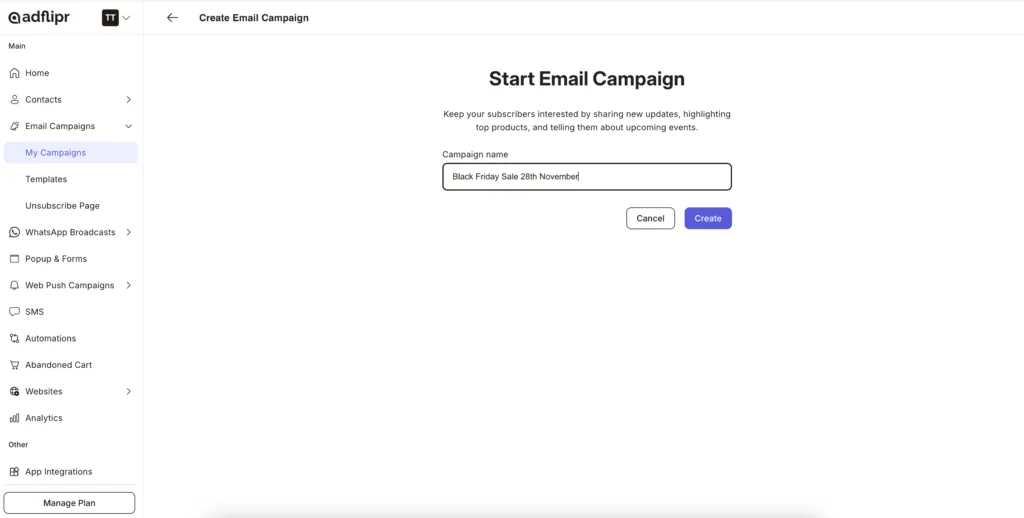
Step 1: Name Your Campaign
Open Email Campaigns, go to My Campaigns and start a new campaign. Give it a name you will recognise later, such as the offer and the send date, so your reports stay easy to read.
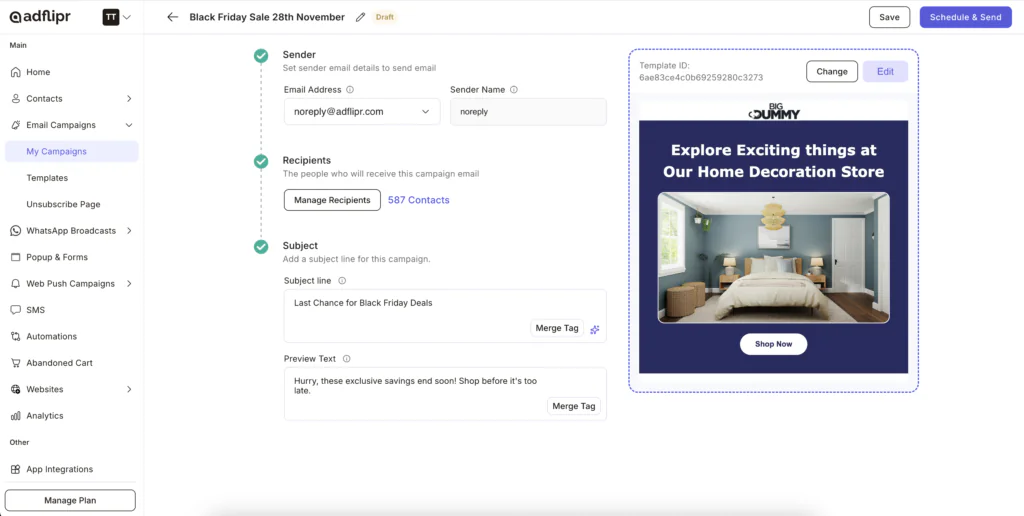
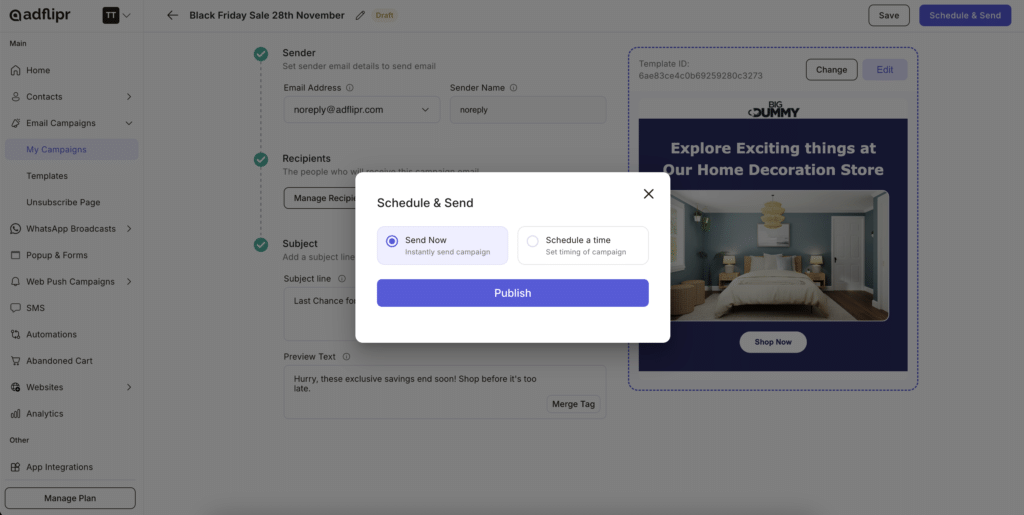
Step 2: Set the Sender, Recipients and Subject Line
The campaign page walks you through three checkpoints: Sender, Recipients and Subject. Each one gets a green tick once it is complete.
- Sender: the email address and sender name your customers see.
- Recipients: who receives the email, with a count of the contacts you have selected.
- Subject and preview text: the subject line and the short preview shown beside it in the inbox. Merge tags let you add details such as the customer’s name.
The example uses the subject line “Last Chance for Black Friday Deals” and the preview text “Hurry, these exclusive savings end soon! Shop before it’s too late.” It leads with the offer and a deadline, in line with the promotional advice earlier in this guide. For more ideas, see these best subject lines for email marketing.
Tip: the example sender is “noreply”. For your own campaigns, use a recognisable brand name and an address you actually monitor, so customers who reply reach a real person.
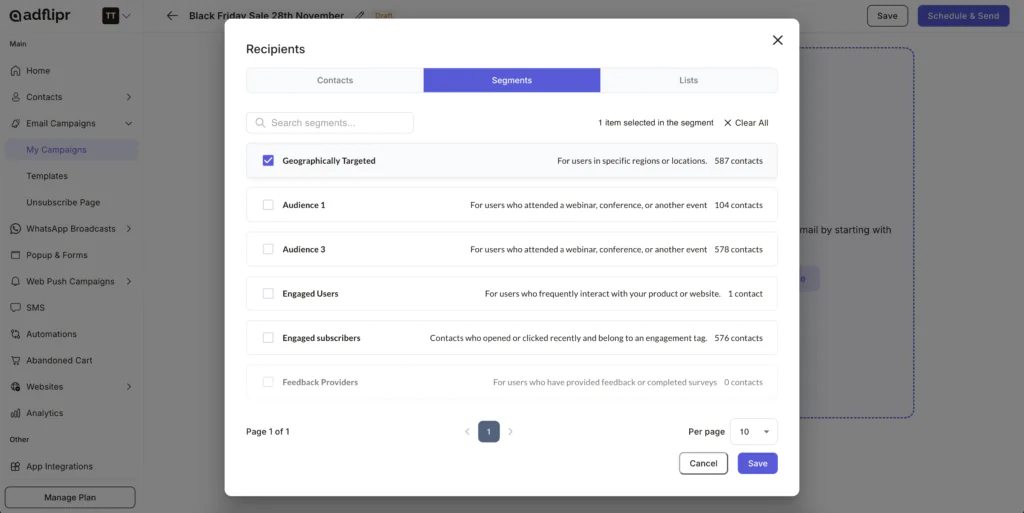
Step 3: Choose Who Receives It
Select Manage Recipients to open the recipients pop-up. It has three tabs: Contacts to pick individual people, Segments for saved groups, and Lists for the lists you have organised. Every option shows how many contacts it contains, and the pop-up tells you how many items are selected.
Choose the group that fits the goal in your campaign brief. In the example, a segment such as Engaged subscribers (contacts who opened or clicked recently) lets you send to people who actually read your emails, which protects deliverability. To build better groups, read our guide to email marketing segmentation and explore Adflipr’s contact management features.
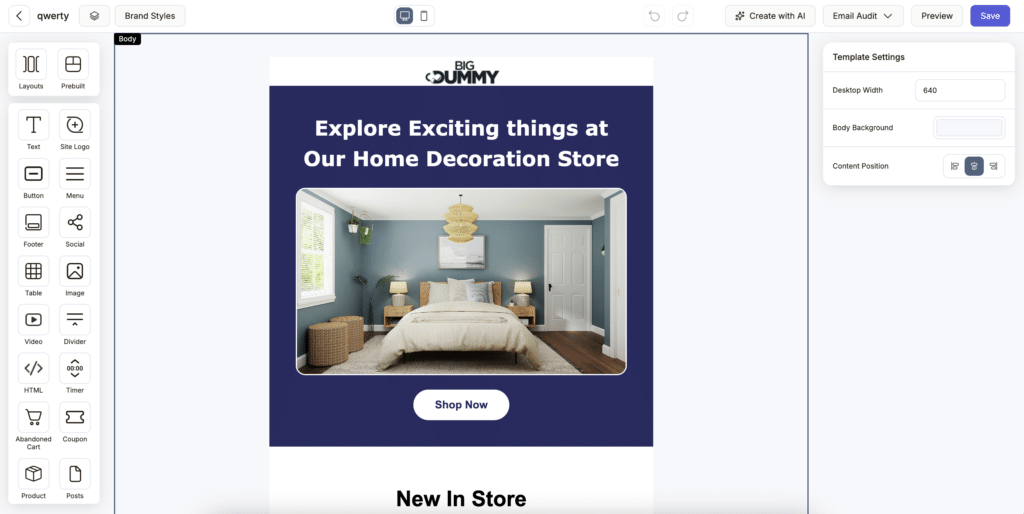
Step 4: Design the Email in the Drag and Drop Builder
Select Edit beside the template to open the drag and drop email builder, or Change to start from a different template. You can also browse ready-made email templates. Content blocks sit on the left, your email in the centre and the settings on the right.
Blocks include text, logo, button, menu, footer, social links, table, image, video, divider, HTML, timer, abandoned cart, coupon, product and posts. A few features are worth knowing:
- Brand Styles keeps your colours and fonts consistent across emails.
- The desktop and mobile toggle lets you check both views, which matters because most emails are read on phones.
- Preview shows the email as readers will see it before you send.
- Create with AI helps you start from a draft instead of a blank page.
Keep the design focused. The example uses one headline, one image and a single Shop Now button, which follows the one-goal, one-call-to-action rule from the best practices below.
Step 5: Schedule or Send
When the sender, recipients, subject and design are ready, select Schedule & Send. Choose Send Now to send instantly, or Schedule a time to set when the campaign goes out, then select Publish. Select Save at any point to keep the campaign as a draft and come back to it later.
For most campaigns, scheduling is the better choice. Pick the day and hour you wrote in your planning brief, and check the desktop and mobile previews first.
Step 6: Check the Results
After the send, open the campaign report. It has Overview, Engagements and Orders tabs. The Key Insights panel shows sent, delivered, failed, soft bounce and hard bounce counts, unique and total open rates, unique and total click rates, click-to-open rate, unsubscribe rate, orders and revenue. A campaign activity feed lists each delivery, open and click.
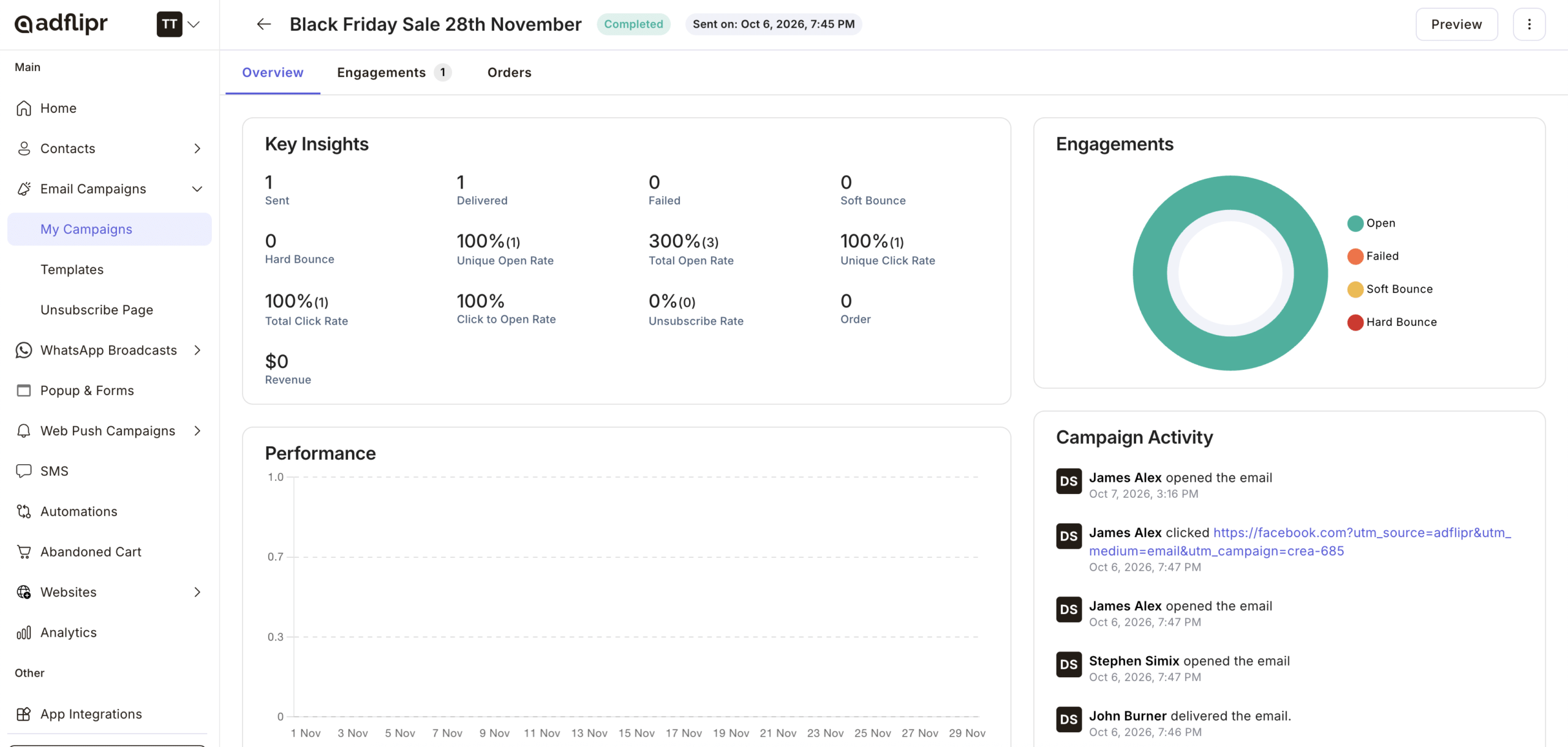
Compare these numbers with the metrics table below, and use the holdout test to check how much revenue the campaign really created. Ready to build your own? Explore Adflipr email marketing.
Email Campaign Planning Template (Copy and Reuse)
Fill in this one-page brief before you build any campaign. If you cannot complete a row, the campaign is not ready to send.
| Field | What to Write | Example |
|---|---|---|
| Goal | One measurable result and a deadline | 50 orders in 7 days |
| Audience | The segment and how many people are in it | Customers who bought in the last 90 days |
| Offer | The single thing you are asking them to act on | Free shipping until Sunday |
| Subject line and preview text | Two versions to test, if your list is large enough | “Free shipping ends Sunday” / “Your picks are waiting” |
| One call to action | One button leading to one destination | “Shop the sale” |
| Send time | Day, hour and time zone | Tuesday, 10 AM in the subscriber’s time zone |
| Success metric | The number you will judge it by, chosen before sending | Revenue per recipient compared with a holdout group |
| Follow-up | Who gets a reminder, and when | Non-openers get a resend after 48 hours with a new subject line |
Keep a copy of every completed brief. After a few months you will have a record of what works for your own audience, which is worth more than any industry benchmark.
Email Campaign Best Practices That Separate Good from Great
Segment Before You Send
Unsegmented broadcasts tend to underperform targeted campaigns. Even basic segmentation by new vs. returning customers or engaged vs. inactive subscribers produces meaningfully better results.
Personalise Beyond First Names
True personalisation means recommending products based on past purchases, sending birthday offers, and timing messages based on individual behaviour. First-name merge tags are a starting point, not a strategy.
Optimise for Mobile First
Most emails are now opened on mobile devices. Design for the phone screen first, then verify the desktop experience. A campaign that renders poorly on mobile loses the majority of its potential.
A/B Test Every Major Campaign
When your list is large enough for a fair test, try at least two subject line variations on every significant campaign. Over time, consistent A/B testing builds a reliable understanding of what your specific audience responds to.
Send at the Right Time
The best send time varies by audience, but a common starting point to test is Tuesday through Thursday between 10 AM and 2 PM in the subscriber’s local time zone. Use send-time optimisation tools when available, and read our guide to the best time to send email marketing to test this on your own list.
Stop Campaigns Colliding with Automations
A shopper who just received an abandoned cart reminder does not need a 30% off blast an hour later. Suppress contacts who are in an active cart recovery or welcome flow from promotional campaigns for 24 to 48 hours, so your emails support each other instead of competing. It also protects your margin, because you avoid discounting for someone who was already about to buy.
Keep Your List Clean
Inactive subscribers who never open harm your deliverability. Run re-engagement campaigns quarterly and suppress those who do not respond. A smaller, engaged list outperforms a large, cold one every time. This guide on email list management covers the best practices for keeping your list healthy.
Key Metrics to Track for Every Campaign
Measuring the right things determines whether your email campaign strategy improves over time or stays flat.
| Metric | What It Measures | Benchmark |
|---|---|---|
| Open rate | Subject line effectiveness | About 30% for campaigns (directional only, because Apple Mail Privacy Protection inflates opens) |
| Click-through rate | Email body and CTA performance | About 0.7% to 1.7% for campaigns, about 4.7% to 5.6% for automations |
| Conversion rate | Percentage of clicks that result in purchase | About 0.08% for campaigns, about 1.5% for automations |
| Revenue per email | Direct business impact of each campaign | Varies by store |
| Unsubscribe rate | Content-audience mismatch signal | About 0.2% for campaigns; look into it if it stays above 0.5% |
| Bounce rate | List quality and deliverability health | Under 2% |
Open rate and click-through rate tell you how your campaign performed. Revenue per email tells you whether it mattered to the business. Always track both. Benchmarks differ by industry, list quality and how each platform counts clicks and conversions, so treat the figures above as a rough guide and compare them with your own history. They come from Omnisend’s 2025 ecommerce email data (open, click, conversion and unsubscribe rates) and Klaviyo’s 2026 email benchmarks (click rates). Both are email platforms reporting on their own customers, not independent studies.
A note on open rates: since Apple launched Mail Privacy Protection in 2021, many opens are triggered automatically, so treat open rate as a directional signal and rely on clicks, conversions and revenue per email. Our guide to email marketing analytics shows how to read your data after Apple’s change.
For a complete breakdown of eCommerce email benchmarks, the guide on email marketing metrics and benchmarks provides category-specific data to compare your performance against industry standards.
How to Prove a Campaign Actually Made Money (The Holdout Test)
Most email reports credit a campaign with every order from people who clicked it. But some of those customers would have bought anyway. A holdout test shows how much revenue the campaign really created.
- Randomly pick about 10 percent of your audience and leave them out of the send. This is your holdout group.
- Send the campaign to the other 90 percent.
- When the sales window closes (for example after 7 days), work out revenue per person for both groups.
- Multiply the difference by the number of people who received the email. That is the extra revenue the campaign created.
Worked example (illustrative numbers):
| Group | People | Revenue | Revenue per Person |
|---|---|---|---|
| Received the email | 9,000 | $13,500 | $1.50 |
| Holdout (no email) | 1,000 | $1,000 | $1.00 |
A standard report might credit the campaign with the full $13,500. The real lift is only $0.50 per person: $0.50 x 9,000 = $4,500 of extra revenue. The rest would have arrived without the email. These numbers are made up to show the maths, so use your own.
The test works best with a large enough audience and a truly random split. On a small list, repeat it across several campaigns before drawing conclusions. To read the rest of your results, see our guide to email marketing analytics.
Automated Email Campaigns: Set Once, Run Forever
The most efficient eCommerce email campaigns are not sent manually. They are automated workflows that trigger based on subscriber behaviour, purchase history, or lifecycle stage.
The five automated campaigns every eCommerce store should have running:
| Automation | Trigger | Revenue Impact |
|---|---|---|
| Welcome series | New subscriber | High: converts interest into first purchase |
| Abandoned cart | Cart abandonment detected | Very High: direct revenue recovery |
| Post-purchase | Order placed | Medium: drives reviews and repeat sales |
| Browse abandonment | Product viewed, no cart added | Medium: captures early-stage intent |
| Win-back | 90 days of inactivity | Medium: reactivates dormant revenue |
Once these five are live, they generate revenue continuously without requiring a team member to plan, write, or schedule them. That is the compounding advantage of automation over manual campaign sending.
You can build all five in Adflipr’s marketing automation builder, using the drag and drop email builder to design each message. To understand how automated workflows are built and structured, this guide on what is email automation covers the foundational concepts for eCommerce stores.
Email Campaign vs Newsletter vs Automation vs Flow: What Is the Difference?
These terms are often used interchangeably, but they describe different ways of sending email. Knowing which one you need keeps your planning clear.
| Term | What It Is | Example |
|---|---|---|
| Campaign | A one-off or scheduled send to a chosen audience, built around a single goal | A Black Friday sale announcement sent on a set date |
| Newsletter | A regular, value-led broadcast sent on a fixed schedule | A monthly roundup of new arrivals and styling tips |
| Automation | An email or series triggered by what a subscriber does, running without manual sending | An abandoned cart reminder sent one hour after a shopper leaves |
| Flow | A multi-step automation that branches based on behaviour | A welcome flow that splits buyers from non-buyers after the second email |
| Drip campaign | A pre-written sequence sent on a timed schedule | A five-email onboarding sequence spread over two weeks |
Most stores need all of them: calendar campaigns for seasonal spikes, a newsletter to stay top of mind, and automations that earn revenue every day. If you are new to automation, start with our guide on what is email automation.
Campaign Calendar: When to Send What
Plan your promotional email campaigns around the commercial calendar. Trying to build campaigns during peak periods is stressful and produces lower quality work. Build in advance.
| Quarter | Key Campaign Opportunities |
|---|---|
| Q1 (Jan to Mar) | New Year sale, Valentine’s Day, end-of-winter clearance |
| Q2 (Apr to Jun) | Spring collection, Mother’s Day, mid-year sale preview |
| Q3 (Jul to Sep) | Summer sale, back-to-school, early autumn refresh |
| Q4 (Oct to Dec) | Halloween, Black Friday, Cyber Monday, Christmas, year-end clearance |
Layer your automated campaigns underneath this promotional calendar. The automation handles the always-on revenue while the calendar campaigns drive seasonal spikes.
Common Email Campaign Mistakes to Avoid
| Mistake | Why It Costs You |
|---|---|
| Sending to your full list every time | Irrelevant emails drive unsubscribes and damage deliverability |
| No clear call to action | Readers do not know what to do next |
| Inconsistent sending schedule | Subscribers forget who you are |
| Ignoring mobile rendering | Frustrates the many subscribers who read email on their phones |
| No post-campaign analysis | Prevents learning and improvement over time |
| Using misleading subject lines | Destroys trust and spikes unsubscribe rate |
For a structured way to identify gaps in your current email program, this email marketing audit guide walks through every element worth reviewing.
Email Deliverability Checklist: Make Sure Your Campaigns Reach the Inbox
A perfectly planned campaign earns nothing if it lands in spam. Run through this checklist before every major send.
- Authenticate your domain. Since February 2024, Gmail and Yahoo expect senders to authenticate with SPF and DKIM, and bulk senders must also publish a DMARC record that aligns with the From domain.
- Make unsubscribing easy. Marketing emails to Gmail and Yahoo users need one-click unsubscribe, and opt-out requests should be honoured within two days. Keep a visible unsubscribe link in the footer as well. See our unsubscribe footer best practices.
- Keep spam complaints low. Stay under 0.3 percent, and ideally under 0.1 percent, measured in Google Postmaster Tools.
- Send to people who asked for it. Use a clear opt-in, suppress inactive subscribers and remove addresses that bounce. Learn the difference between hard and soft bounces.
- Check your content. Avoid misleading subject lines, image-only emails and broken links. See what an email spam score means and how to improve it.
If your campaigns are already landing in spam, our guide on why emails go to spam lists the most common causes and how to fix them.
Frequently Asked Questions (FAQs)
An email marketing campaign is a targeted series of emails sent to a specific audience with a defined goal, such as driving purchases, recovering carts, or nurturing new subscribers.
It depends on the campaign type. Promotional campaigns often need 1 to 3 emails. Welcome and nurture sequences typically run 3 to 7 emails spread across several days.
Tuesday through Thursday between 10 AM and 2 PM in the subscriber’s local time zone often performs well for eCommerce audiences, but the best time varies, so test it on your own list.
Track open rate, click-through rate, conversion rate, and revenue per email. Revenue per email is the most direct measure of whether a campaign delivered business value.
A campaign is manually scheduled for a specific date. An automation triggers automatically based on subscriber behaviour, such as joining a list or abandoning a cart, and runs continuously without manual input.
There is no universal number. Many stores start with one or two campaigns a week, then adjust by watching clicks, unsubscribes and spam complaints and testing frequency on engaged subscribers. Only email people who opted in, and remember that automated flows run on top of your regular schedule.
The eight core types are welcome, promotional, abandoned cart, drip, re-engagement, post-purchase, newsletter and win-back campaigns. Most online stores run all eight over the course of a year.
Authenticate your sending domain with SPF, DKIM and DMARC, include an easy unsubscribe link, keep spam complaints below 0.3 percent and only email people who opted in. See the deliverability checklist above.
A campaign is built around one specific goal, such as a sale or product launch. A newsletter is a regular, value-led broadcast sent on a fixed schedule to keep subscribers engaged.
Start with a welcome series, then an abandoned cart sequence. They reach people who have already shown interest, so they tend to pay back fastest. Add a post-purchase review request next, then promotions and win-back campaigns as your list grows.
Hold back a random 10 percent of the audience, send the campaign to the rest, then compare revenue per person between the two groups. The difference is the revenue the campaign actually created. See the holdout test section above.